


Jan Gehl has a method. The Danish architect who has spent sixty years studying how people actually use streets didn’t start with plans or zoning maps or density calculations. Instead, started with a folding chair.
He puts the chair on the sidewalk. He sits down. And he counts.
He counts…How many people walk past in an hour? How many of them stop? How many look in a window? How many talk to each other, or how many sit down somewhere. How many are children. How many are old. How many are alone. He does this on street after street, city after city, and he writes the numbers in a notebook, and from those numbers — not from theory, not from ideology, not from a consultant’s rendering — he builds his understanding of what makes a street work.
One of the most numbers Gehl ever produced was this: on streets where the ground-floor frontage changes every five to seven meters (approximately 17 to 22 feet) — a new door, a new window display, a new awning, a new texture — pedestrian activity is seven times higher than on streets where the frontage is monotonous. Seven times. Not ten percent more. Not twice as much. Seven times.
Gehl called it the five-second rhythm. At walking speed (about 3 miles per hour, or roughly 4.4 feet per second) you cover approximately 22 feet every five seconds. If something new happens in the streetscape every 22 feet, your brain keeps clicking. You keep walking. You want to look. You maybe linger. Perhaps you even stop or come back. If nothing changes for fifteen or twenty seconds, if you are walking past the same wall, the same material, the same blank surface, your brain checks out. You grab for your phone. Any new messages? Your feet speed up. You are no longer in a place. You are passing through.
This is neuroscience. Our human brains are wired to seek novelty, a survival mechanism that once kept us scanning the savanna for predators and now keeps us doomscrolling through feeds. Cognitive scientists call it the orienting response: when something new enters your visual field, your attention snaps to it. Maybe it’s a painted yellow door. A funky window display with plants. A person wearing a wild and strange outfit. Each one resets your brain’s attention stopwatch. And each one gives you a reason to stay present in the physical world rather than retreat into the one in your pants pocket. When the smartphone offers infinite novelty at zero physical effort, the streetscape has to compete, not with content, but with cadence. A streetscape that delivers richness at walking speed gives you something Instagram filters cannot: the feeling of being somewhere.
Remember, something new every five seconds. Five.
I think about that number every time I walk past most development, similar to the point made by Matthew Yglesias in the tweet below:


Why Does New Development Feel Like That?
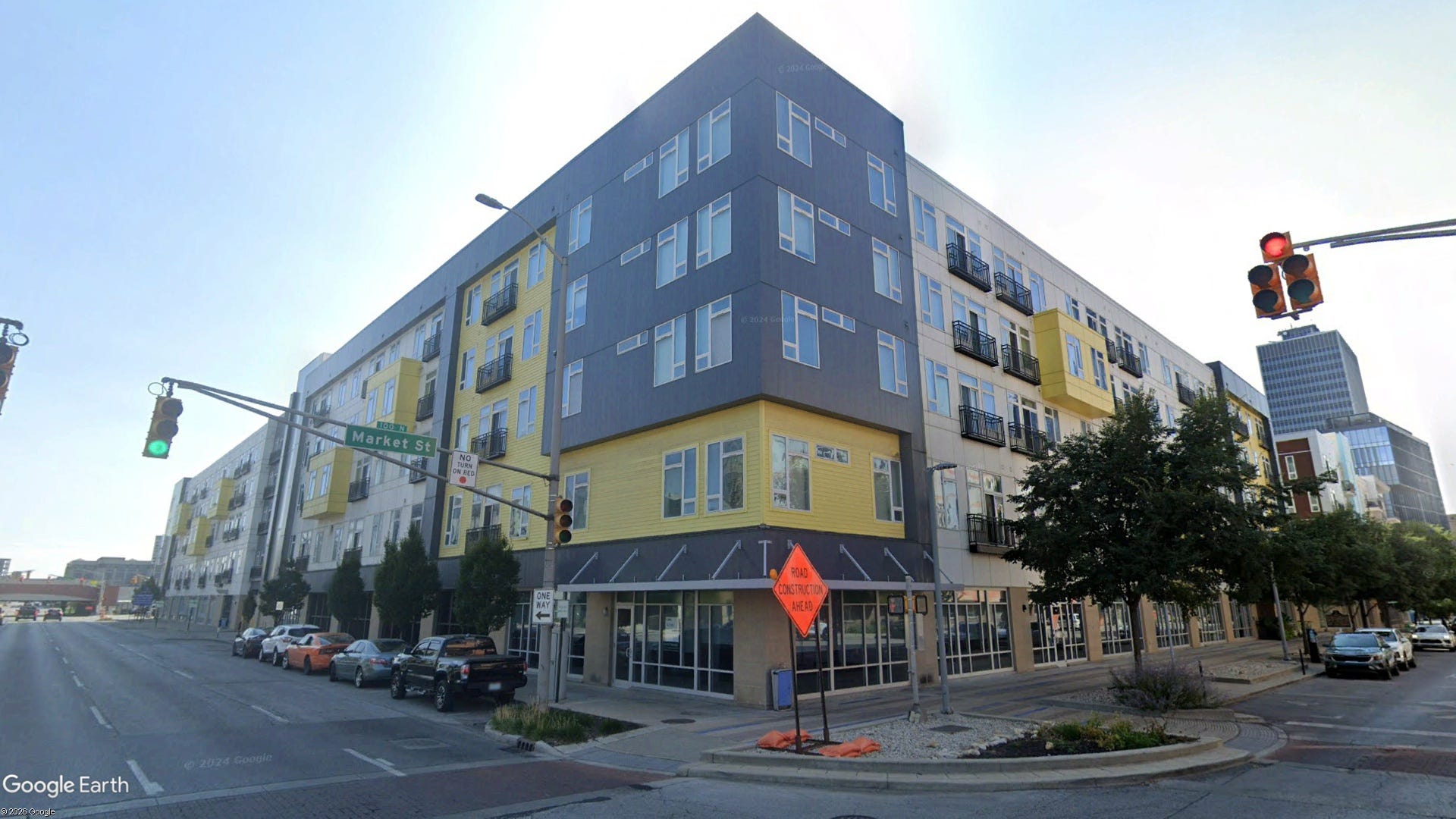
You may be asking why new development feels like this but you already know the kind of building I’m talking about. You may not know the name, but you know the building. A few stories of wood-frame apartments over one story of concrete — the concrete level is either parking or retail, usually parking with a thin veil of retail stretched across the street-facing side. The exterior is a patchwork of fiber cement panels in two or three colors, arranged in a pattern that a computer generated and no human would have chosen. The building is long. It occupies an entire block face, sometimes two. It has a lobby entrance and maybe, if the city required it, a retail bay or two at the corner. The residential floors above are accessed through interior corridors. The windows are uniform. The balconies, if present, are unused, too small for a chair, and too exposed for comfort, decorative appendages that exist to break up the facade on the architectural rendering and serve no function in the lives of the people behind them.
The five-over-one is the defining multifamily building type of 21st-century American development, not because it is the most frequently built, but because it is the most visible, the most replicated across markets, and the most responsible for the increasing homogeneity of the American streetscape. It dominates new construction in growing cities like Austin, Nashville, Denver, Indianapolis, Raleigh, Columbus. It is the product of a specific intersection of building code (the 2009 International Building Code allowed five stories of Type V wood-frame construction over one story of Type I concrete), lending practice (banks love the predictable returns of a 200-unit building with standardized floor plans), and zoning reform (cities that relaxed height limits and use restrictions got more of these, fast). The five-over-one and development like it is what the development industry builds when you remove the most restrictive barriers but leave the underlying incentive structure (build big, build fast, build standardized) intact.
And by every metric that planners currently use to evaluate urban development, the five-over-one is a success.
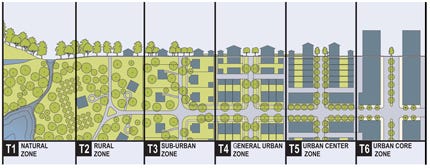
It is dense. A five-over-one on a half-acre lot easily delivers sixty to eighty dwelling units per acre, well above the threshold for what is deemed transit-supportive density. It is mixed-use, at least nominally. There is typically some retail on the ground floor, even if the retail is a leasing office or amenity space and a package room. It meets the form-based code’s requirements for build-to line (the building is pulled up to the sidewalk), ground-floor transparency (the code says sixty percent, the architect delivers sixty percent), and street wall continuity (the facade is unbroken for three hundred feet). On the DPZ transect, the five-over-one lands comfortably in T5, Urban Center. On the SmartCode’s standards, it passes.
So why does it feel dead?
What is an Active Edge?
Before we get to how some places feel dead and others don’t, we should discuss what we mean by active edge. An active edge is composed of things that catch your attention. It’s a qualitative feeling but can certainly be qualified in numbers. Walk along a block and ask yourself, “how many cool or neat things can I count within every 100 feet?” If that number is less than, say, something like 5, it’s probably not an engaging block. If it’s more than 20, then the block sounds way more engaging and is probably far more interesting to be on. We call these neat or cool items Active Edge Elements.
It’s also important to remember where our eyes go. Typically for pedestrians, we only really acknowledge things between the first couple stories and typically not above five stories. Those first two are the most important. Because we can still see and probably yell to that second story, it can be as just as much an edge as the oft-cited first floor. This is partially why the roads of New Orleans’s French Quarter or Condesa or Roma in Mexico City feel so intimate - their multistory porches let life and music bleed into the public outside. They are porous.
When Jan Gehl counted storefronts in Copenhagen and established the five-second rhythm (fifteen to twenty active frontage elements per roughly 330 feet, one scene change every 17 to 22 feet at walking speed) he was counting on commercial streets. Mostly doors that customers use. Windows with merchandise. Outdoor seating where people eat food they just bought. The method works and is a widely cited metric for street-level vitality in the urban design literature. But it has a big blind spot.
Gehl’s counting method has a problem the moment you try to apply it outside a retail corridor. It assumes that activity at the ground plane is commercial activity. That the door matters because a customer walks through it. That the window matters because a product is behind it. That the surface matters because it is selling something.
But this assumption excludes most of the world’s neighborhoods from the conversation.
When I walk down my neighborhood streets, I can’t relate with the Bund in Shanghai or the West End of London; neighborhood corridors like mine typically don’t show up in urbanist photoshoots. We have a regular street. Bungalows and shotgun houses. Not much retail. No restaurants. By Gehl’s commercial metric, the ground-plane openings score is near zero. Two or three doors per hundred feet, none of them serving customers. Blank residential facades. No active edges and a dead street, right?
This couldn’t be more wrong!
Let’s look at what is actually there.
The house on the corner has a porch with fourteen plants in mismatched pots — terra cotta, plastic, a coffee can, something that used to be a colander (I think). The plants spill over the railing and onto the steps. They are not landscaping. They are not designed at all. They are an accumulation of one person’s decisions over multiple growing seasons, and they are visually dense enough to stop your eye for three full seconds as you walk past. Even if you’re mostly questioning where some of the pots came from - or what they were - it’s enough to get your attention. That’s an active edge.
Next door, someone has hung a string of Christmas lights across the porch ceiling. They’ve been up since two Christmases ago. Half of the lights are still on at night, the other half with blown bulbs from overuse. Below them, two lawn chairs face the street. A pair of heavily worn shoes sits by the door. The porch is not occupied right now, but the signs of occupation are everywhere — a crusty coffee mug on the railing, an overfilled ashtray, a phone charger snaking through the window next to an AC unit. This porch is a room with no walls, and it is furnishing the street with evidence that someone is there. Remember, intrigue and novelty are the spice.
Next door, a man we call Chicken Paul has a front yard littered with wire fencing and, you guessed it, chickens. A ridiculous number of chickens. If you’re unlucky, you may also catch his very large and very loud Rottweiler vociferously protecting the domain of Chicken Paul. This is CP’s world, we’re just living in it. This is an active edge we avoid (at times).
Three houses down, the garage door is covered with a mural. It is not a commissioned piece. This is not Banksy. It looks like a child, maybe a teenager, painted it — a sun, some flowers, a word in script that might say “blessed” (or possibly “breathe” it is hard to tell when I walked past). But that doesn’t matter. The mural is a signal that someone cared enough about something to write it down in paint. That signal is an active edge.
Across the street, a chain-link fence is threaded with plastic flowers. Next to it, a yard with a hand-painted sign that says “Slow Down Children Playing” in letters that are not quite straight. The sign has seen better days - perhaps it was a victim of someone not heeding its advice. Next to that, a house with a neon sign in the rounded second floor window, one of those Milwaukee’s Best signs probably stolen from a bar, glowing careless blue hues in the middle of a Spring afternoon. It is not advertising really much of anything. It might make a cold beer sound good, but really it is just someone’s idea of what a window should be.
Every single one of these builds an active edge.
Redefining the Frontage Event
We’ve established that an active edge is the mosaic of interest of the ground-plane interface between a building (or lot) and the street that captures the attention of a person moving at walking speed. An active edge is one that builds novelty. That is the definition. Not “any commercial frontage element.” Not “any door that serves customers.” Any element that engages the eye. Not necessarily the 60% (or other arbitrary number) of transparency required, as many of our zoning codes would prefer.
This matters because the neuroscience behind Gehl’s five-second rhythm isn’t focused on commercial activity. It is about novelty processing. The human brain’s dopamine system, the reward circuitry that motivates exploration and learning, is activated by unexpected stimuli. A predictable environment produces habituation: the brain stops paying attention. A varied environment produces engagement: the brain stays alert because the next stimulus might be rewarding. The five-second rhythm works not because there is a store every five seconds but because there is something different every five seconds. The rhythm is perceptual, not commercial.
A porch with fourteen plants in mismatched pots is a novelty event. Now, if every house had fourteen plants, would it be? We crave the unexpected, so what is deemed novel truly depends on the context in which you're at. Truly vibrant places are built by and for a myriad of different people with different experiences and stories - these places reflect the ethos of “it takes a village” necessary for dynamic urban life.
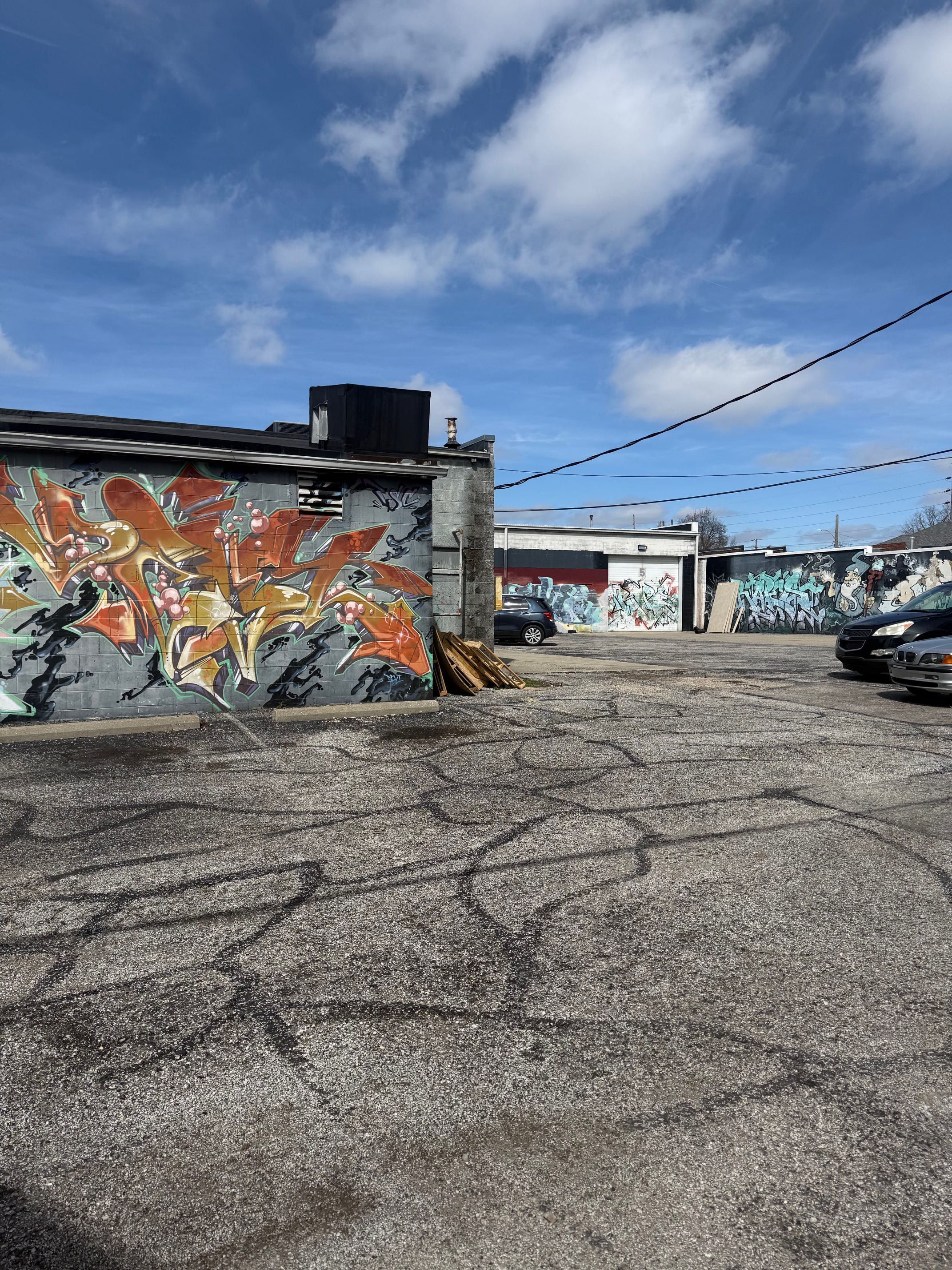
When I say a street has high active edge elements, I do not necessarily mean it has to have a lot of shops. I mean it has a lot of moments or a lot of places where the boundary between the private world of the lot and the public world of the street becomes permeable to attention and creates novelty. The attention can flow inward (you notice the plants) and outward (the person on the porch notices you noticing). That bidirectional flow of attention is osmosis. It is what makes a street feel watched, inhabited, alive. And it happens on residential streets as readily as on commercial ones. But only if the residential fabric is fine-grained enough, porous enough, and human enough to produce it. The term “Active Edge Element” = a slice of novelty. Remember that for later.
What Kills the Active Edge
The difference between an active edge and what I term a ‘lame edge’ is the active edge intrigues while the lame edge bores. The active edge dies when the interface between building and street is sealed. A house set back forty feet behind a lawn with no porch, no fence, no planting bed, no yard art, no evidence of habitation visible from the sidewalk — that is a dead edge. The building exists, but it is not participating in the street. It is not offering anything to the pedestrian’s visual field. It could be occupied or vacant and you would not know the difference from the sidewalk.
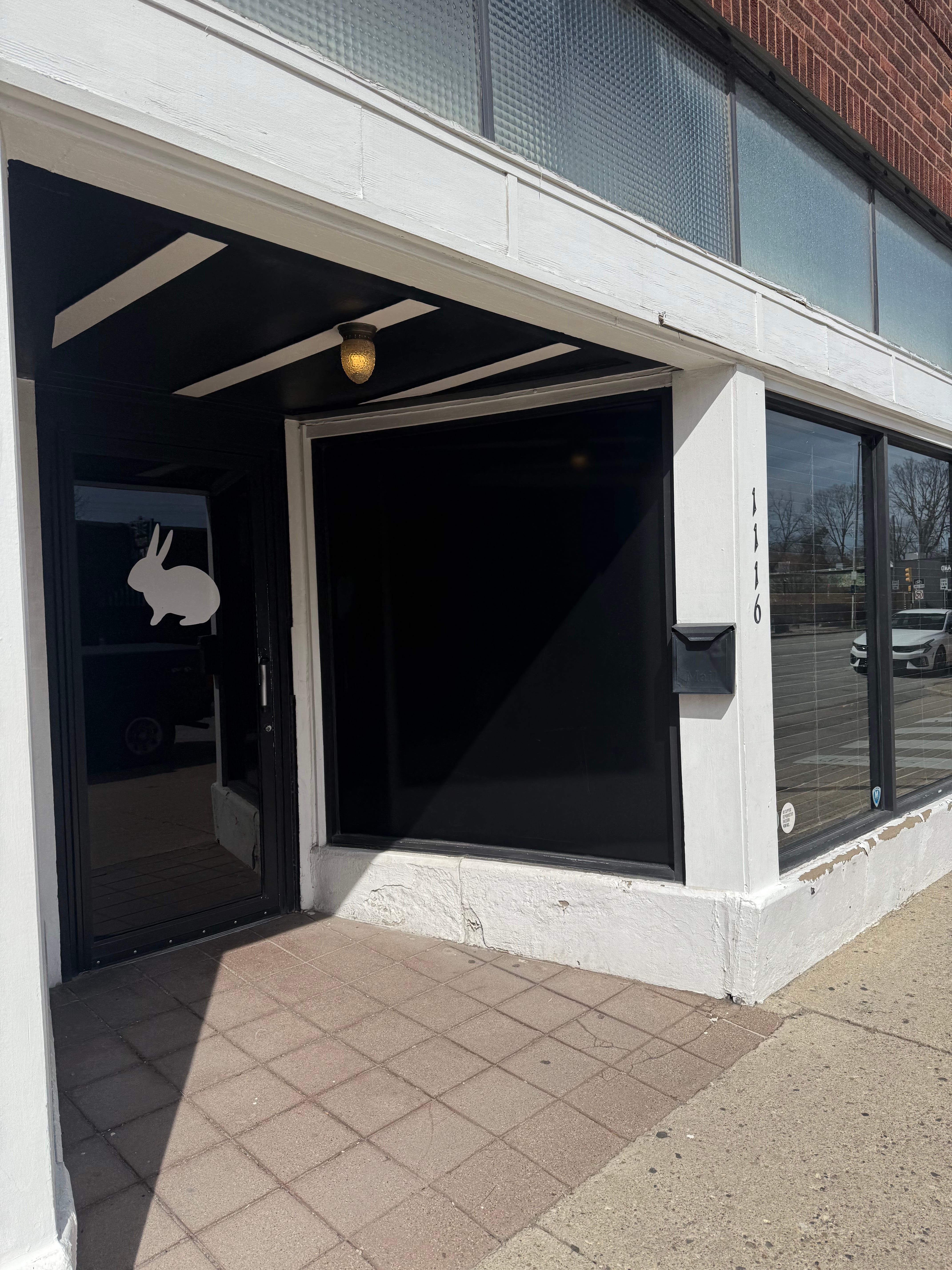
Remember, we’re expanding the definition of what an active edge is. You could have the coolest, most active window display or architecture, but it does not matter if it’s set far across the street where no one can see it. This reminds me a bit of the adage if a tree falls in the woods — if the architecture is great but surrounded by parking lots, was it actually able to be experienced? The relational aspect of buildings is far more important than buildings themselves. Architecture takes second fiddle to relationships between buildings.
A parking lot is a lame edge. A blank wall is a lame edge. A privacy fence taller than eye level is a lame edge. A garage door facing the street (the dominant frontage type in post-1960 American residential construction) is a lame edge. These surfaces do not just fail to attract attention. They actively repel it. They tell the pedestrian’s brain: there is nothing here for you. Speed up. Look at your phone. Get to where you are going.
The five-over-one’s ground-floor parking podium is a lame edge. The strip mall’s setback behind a parking lot is a lame edge. The suburban office building’s reflective glass curtain wall is a lame edge. But so is the ranch house with the two-car garage presenting its blank face to the street while the front door hides around the side. Dead edges are not exclusively a commercial-district problem. They are a residential-district problem, and they are the default product of every American subdivision built after the garage became the primary interface between the house and the street.
But it is not just the long blank wall that kills the active edge. Even if a ground floor is actively being used with businesses it could still be a lame edge. This may because it still bores! Perhaps the street wall is too continuous, perhaps the building is monolithic and repeated. The windows are too predictable, too consistent. This breaks the novelty hunter inside the zona incerta of our subthalamus. This is what Strong Towns contributor Alexander Price has termed “coarse-grained urbanism”.
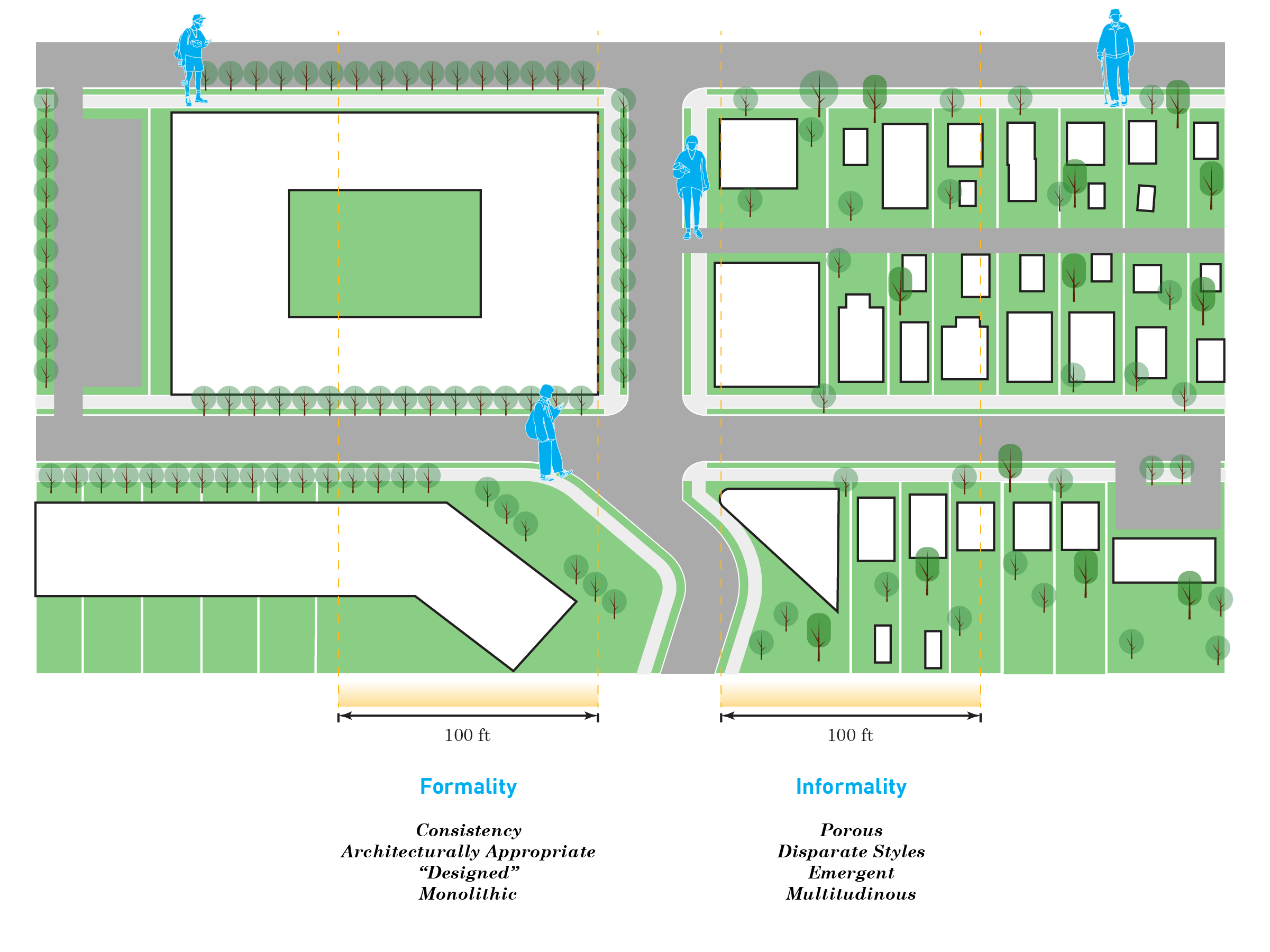
Remember, we want novelty every five seconds or so, so 20-30 feet should have a little something new that activates, brings intrigue. Of course, this naturally occurs in neighborhoods with 25-30’ foot lots and buildings pushed near or up to the sidewalk. A neighborhood built and tended by many hands tends to better reflect the minutiae of daily life and the intricacies of the human experience that the best places often showcase.
Let’s not mistake ourselves: it is not just the five-over-one that is to blame. Our lending and construction practices treat multifamily construction like building a hotel. Our central business districts are filled with large parking garages and convention centers. Our blocks are long, monotonous and boring. It’s our convenient monoculture of development patterns in the 21st century that make lame edges. Some have called this the architecture of neoliberalism. It’s the economies of scale used to build architecture, but not places.
Counting Intrigue
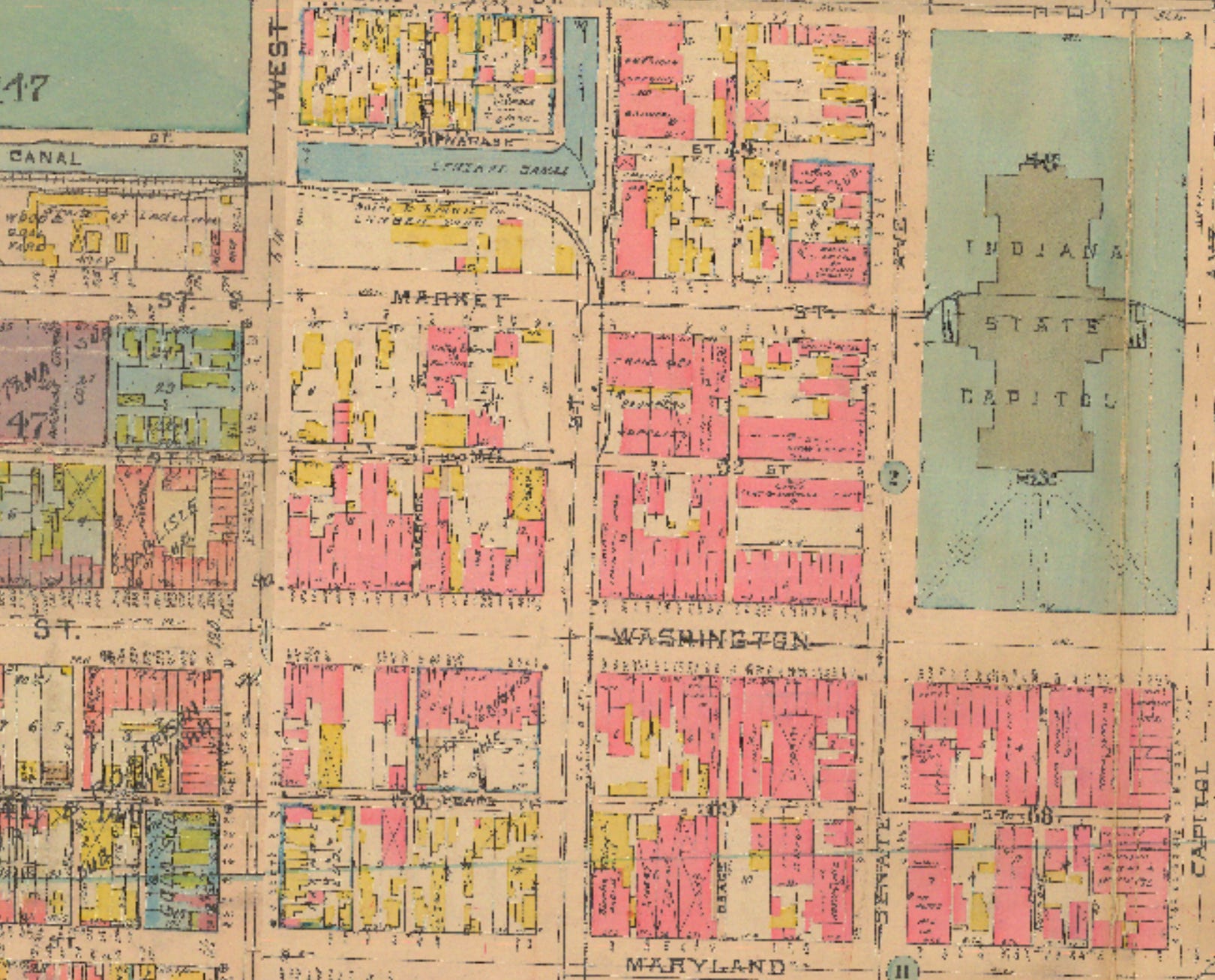
Okay, so what does this all mean? How can we get back to building places that encourage novelty that “make places go”? If the problem is clear — monolithic development patterns have systematically eliminated the fine-grained variety that traditional neighborhoods produced by default — then the response has to be equally clear. We need a way to measure what we're losing. Not in architectural style points or code compliance metrics but in the thing your brain actually registers at walking speed: how many moments of interest does this street give me before I check my phone?
That's a countable thing. And counting it is the first step toward building it back.
Take a walk along your favorite street or block. Keep a count in your head or on a piece of paper. We’re looking to create an average of how many Active Edge Elements happen every 100 or so feet to create a baseline figure.
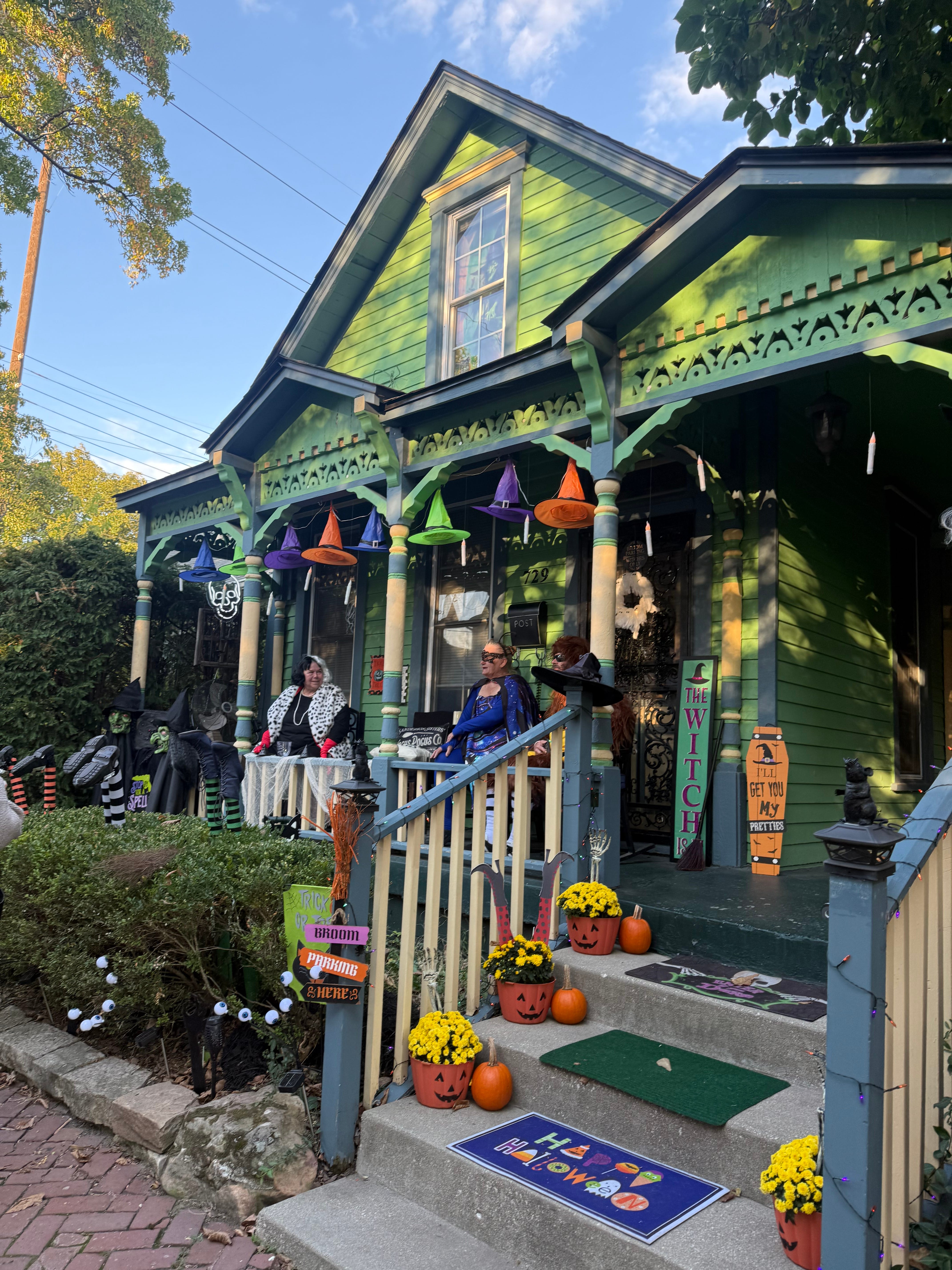
When you use my upcoming scoresheet to count Active Edge Elements (this is a teaser), count everything that engages your eye. Not just doors and windows. Count:
Entries and thresholds. Are there are any interesting doors, gates, stoops, porches, steps, ramps or any point where a person could transition from the public realm to the private realm or where evidence of that transition is visible (shoes by a door, a welcome mat, a screen door propped open)? Extra points for nice porches and patios!
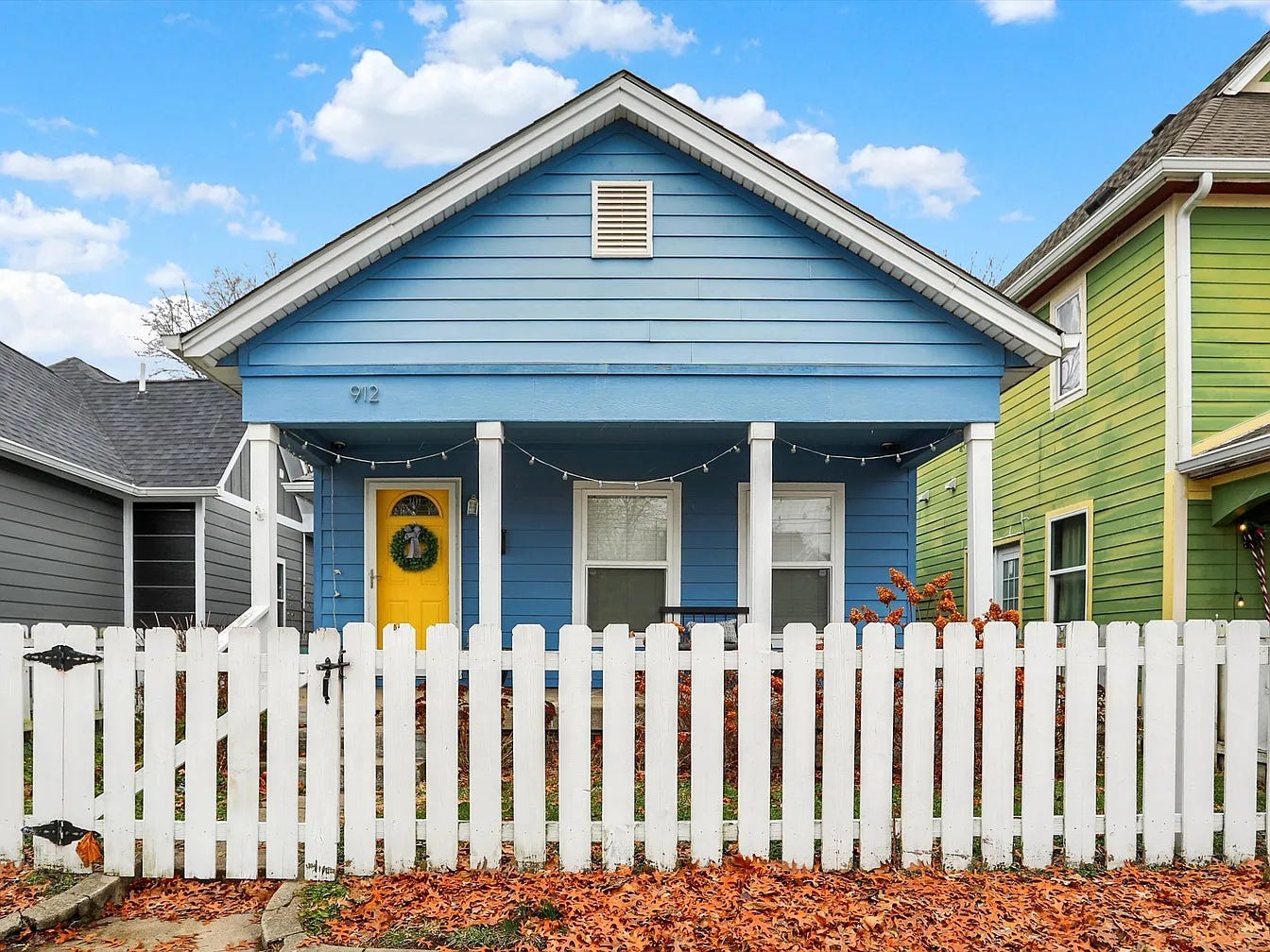
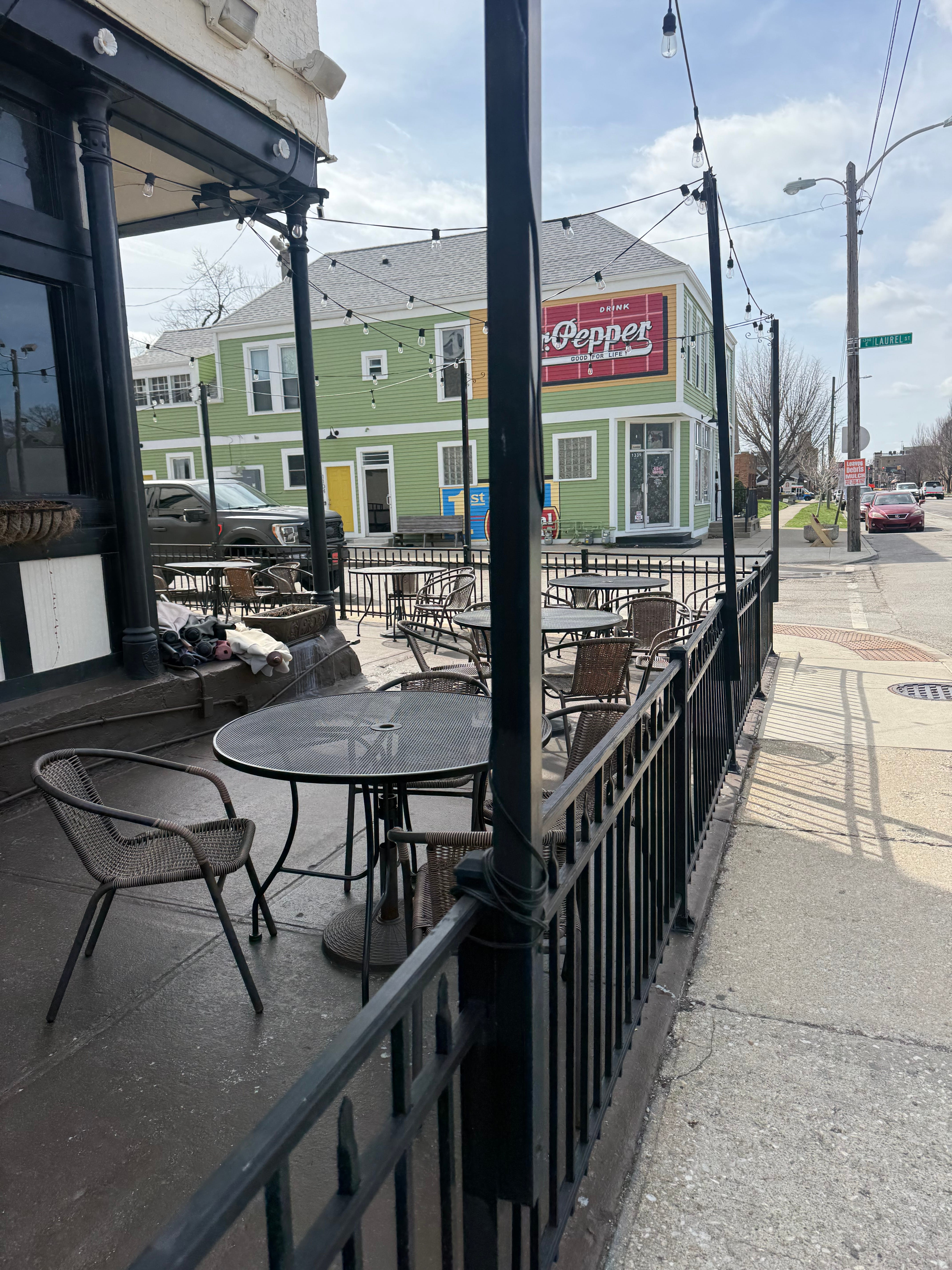
Transparent surfaces. Windows with visible activity behind them — a lit room, a person, a cat, merchandise, art, plants on a sill. Not windows with drawn blinds or reflective film. The test is: can the pedestrian see through the surface into a world that is different from the one they are standing in?

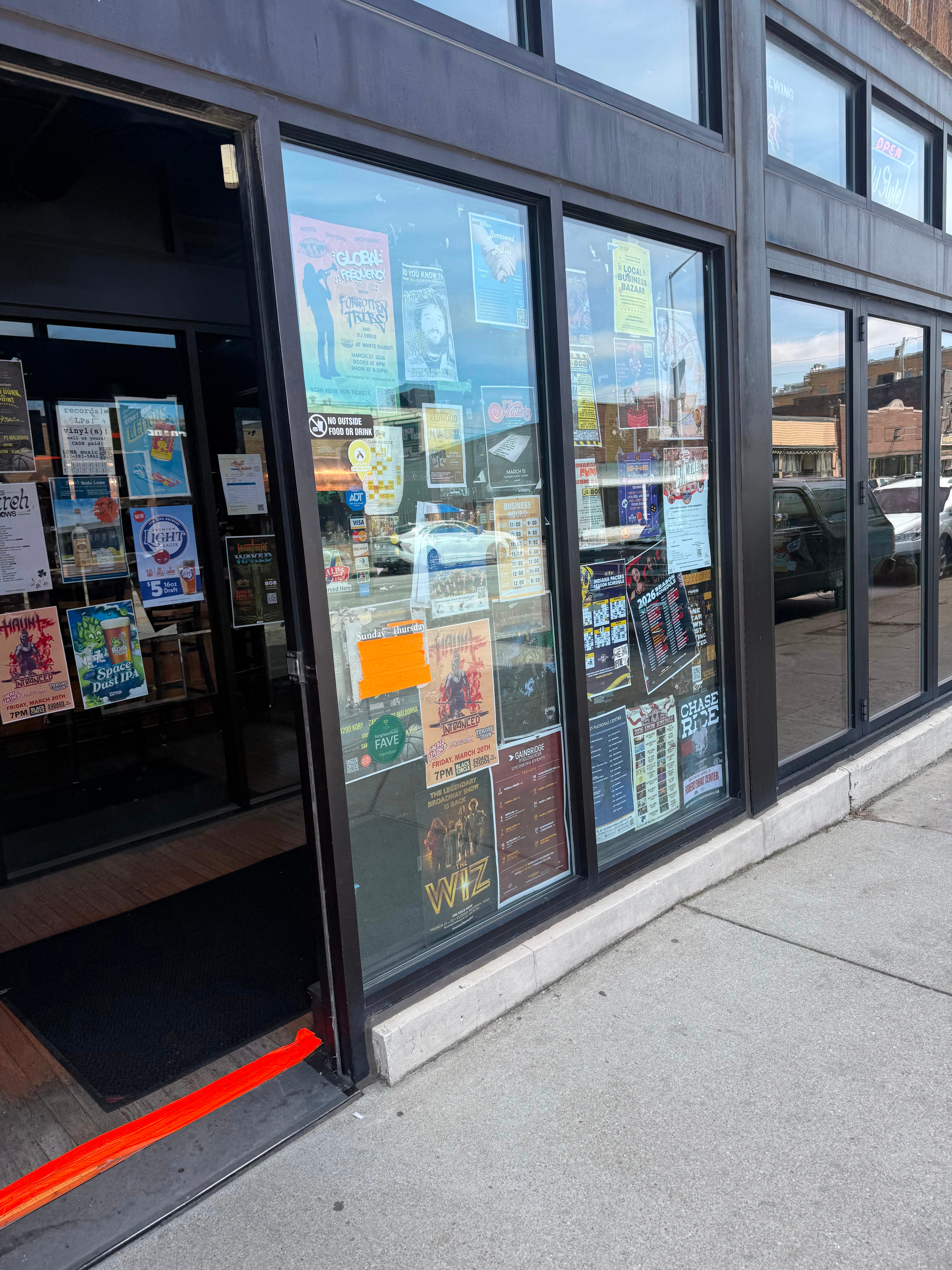
Display and expression. Murals, signs (commercial or personal), art, flags, banners, seasonal decorations, neon, string lights, painted surfaces, chalkboard menus, sandwich boards, posters, bumper stickers on a fence. Any surface that carries a message or an image placed there by a human being with intent.
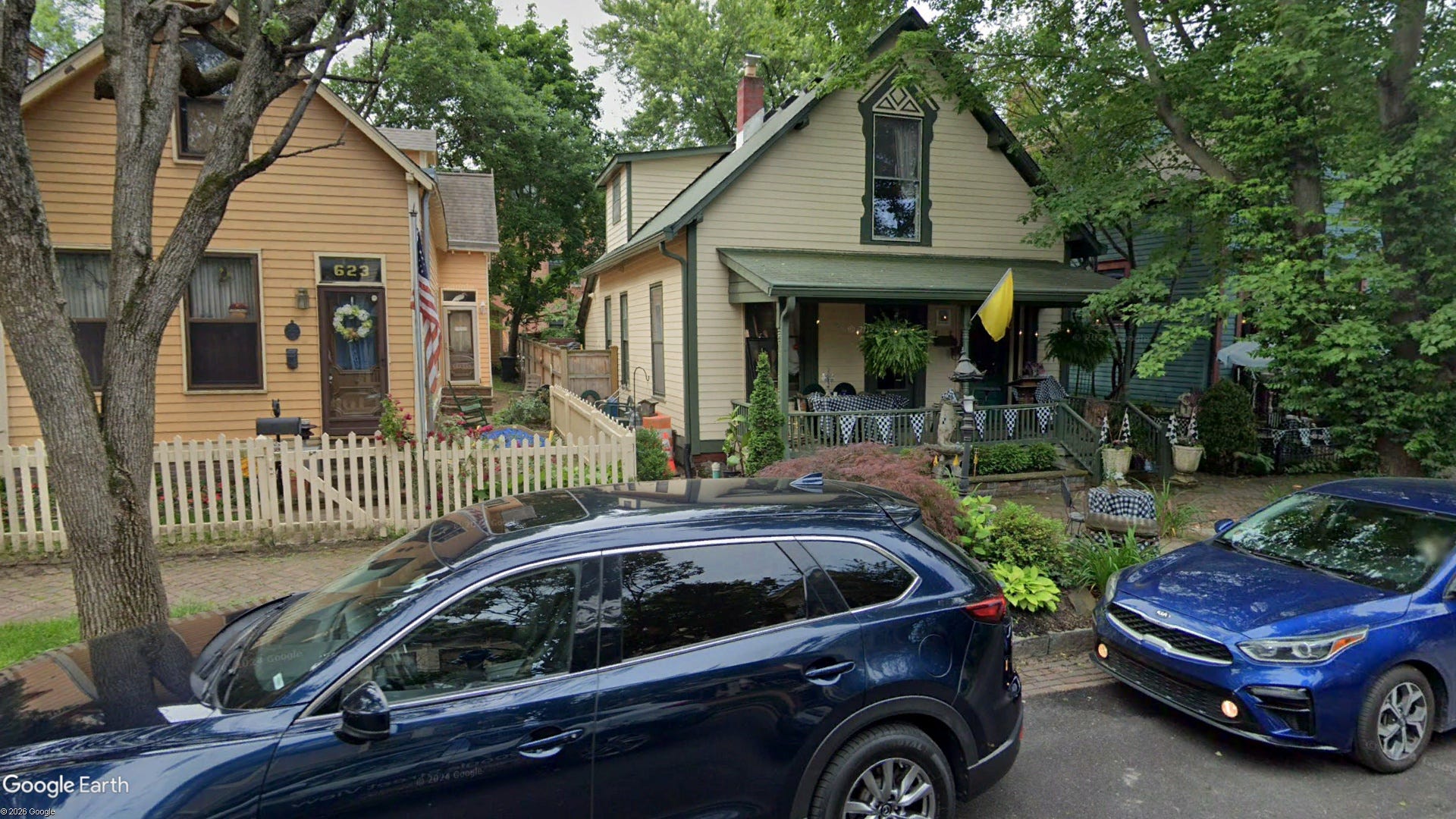
Vegetation and material variety. Planting beds, window boxes, hanging baskets, potted plants, trellises, front gardens, vegetable patches, trees whose canopy creates a visual event at the pedestrian scale. Also material transitions — a brick wall meeting a wood fence meeting a chain-link section threaded with vines. Each material change is a micro-event.
Objects and accumulations. Yard art, sculptures, fountains, birdbaths, garden gnomes, religious statuary, found-object installations, collections visible from the sidewalk can all be active edge elements that bring novelty. But this demands that the objects are done in a way that piques interest or wonder or joy and not disgust. Weird can be good! Is it cool or is it …just sortof weird in a bad way?
Movement and people. Wind chimes, flags, spinning pinwheels, water features, a dog in a yard, a person on a porch, a sprinkler, a bird feeder with birds on it. Movement captures the eye more powerfully than any static element. A street with wind chimes and flags and a dog behind a fence is perceptually richer than a street with none of these, even if the architecture is identical.
But if movement is the appetizer then people are the meal. (I don’t mean this cannibalistically!)
We are social animals wired to scan for other humans: we really are reading faces, gauging body language, assessing whether a place is safe, friendly, worth entering even if unconsciously. There is no architectural detail, no facade treatment, no materiality choice that competes with the sight of another person sitting outside with a coffee.
This is the thing designers don’t want to hear: the presence of people is a stronger predictor of whether a place feels alive than the style of what houses them. A mediocre building with a great porch and someone on it outperforms a great building with a blank wall and no one around. Outdoor seating, visible porches, front yards They say “other people have decided it’s worth being here, so that means it’s safe to stay”. The best architecture in the world cannot replicate what an occupied cafe patio on a sidewalk communicates in a quarter of a second.
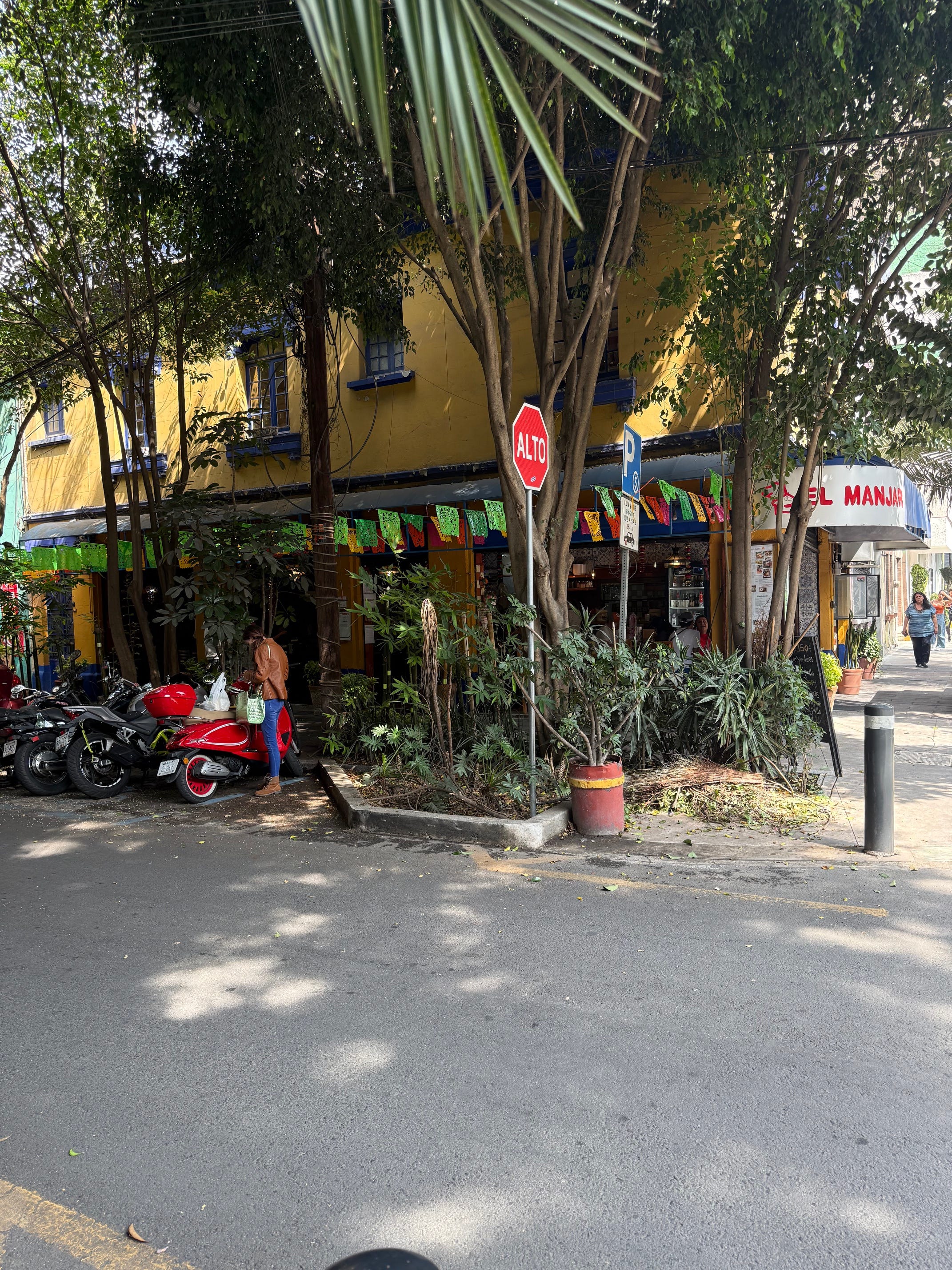
Yes, more people will bring more chances for novelty but that does not mean simply that density = novelty. It’s a built environment that allows those extra people to put their imprint on the space around them that builds novelty. Places that encourage informality in good reason tend to have higher novelty, and thus, feel more like places.
Anyways, the point is not to count every blade of grass in this exercise. The point is to count the decisions — the evidence that individual human beings have made choices about what the interface between their private world and the public street looks like. Each decision is a frontage event. Each event is a beat in the rhythm. And the more beats per hundred feet, the more alive the street feels, whether those beats are storefronts or porches or murals or fourteen plants in mismatched pots. How much cool stuff did you see? Was it an exciting walk? On average, how many neat things did you see every hundred feet?
So, now, me do the exercise. Not in Copenhagen but rather here in Indianapolis. On a block where a five-over-one was recently built.
*Author’s note: I have changed some of these following descriptions slightly to not hurt an architect’s or developer’s personal feelings. It’s not necessarily their fault we build like this, but rather a cosmic gumbo of financing, regulation, and design codes that make it most feasible for economic gain. We can and should code and build better!
I’m standing on the sidewalk on a weekday afternoon. The building is to my left. It runs the entire length of the block, let’s call it 200 or so feet. I start walking. I’m going to see how many cool or neat things I spot each 100 feet.
For the first thirty feet or so, I pass the parking garage. The ground floor here is a concrete wall with horizontal ventilation slits. There is no door. There is no window. There is nothing for my eyes to engage with. The wall is the color of wet cement. My feet speed up without my deciding to speed up. I am in the retail corridor now. Gehl would clock me at zero engagement events in six seconds. I look above, the small Juliet balconies on the slab wall above the retail barely register a depth away from the street wall. There are no active patios from what I can see - no plants, or life. I would clock zero active frontage elements. My brain has checked out a bit already. At least there are street trees?
At the thirty-foot mark, the retail begins. A large glass storefront — a leasing office, I think? Or a lobby? The glass is floor-to-ceiling, which satisfies the transparency requirement, but the interior is a reception desk, a potted plant, and a hallway leading somewhere I cannot see. There is no activity or people inside from what I can discern. The glass functions as a mirror, not a membrane. I can see my own reflection more clearly than I can see what’s inside. Maybe I check myself out. Alright, I’ll call that one active frontage element — me seeing myself — in six seconds.
At the fifty-foot mark, the second retail bay. This one is empty. It has been empty since the building opened years ago. The required rent, which the developer set based on the construction cost of the concrete podium, is something like forty-two dollars per square foot. It seems likely they’ve never intentionally tried to fill it, as they could write it off. A national chain used to operate next door, but that space is now also vacant. The glass is covered with brown paper from the inside. Zero engagement events.
At the hundred-foot mark, another lobby entrance. A glass door with a key fob reader. A hallway leading to an elevator. A sign that says RESIDENTS ONLY LEAVE PACKAGES AT LOBBY. I suppose I could count this as one engagement event, and it’s exclusionary as the door is telling me that the life of this building happens somewhere I am not invited.
The remainder of the space repeats more empty retail, probably written off in the development’s pro forma.
At the two-hundred-foot mark, I reach the end of the block. I have walked the entire frontage of a building that contains two hundred apartments and six thousand square feet of retail space. I have encountered four engagement events. This building is producing engagement at roughly one-quarter of the minimum threshold for pedestrian life.
Now let me do the same exercise on the block that the five-over-one replaced. Except I can’t, because the block is gone. But I can do it on the next block over, which hasn’t been redeveloped. Similar vintage. Similar density. Six buildings instead of one. It’s scruffy.
A couple houses at first, nothing too fancy. A fourplex, it looks like. Not much on the porch. Fifty feet in is a barbershop with its door propped open, radio playing, a man in the chair visible from the sidewalk. Next door is a recently renovated office with a porch where someone has left a pair of boots and a bag of potting soil from the local Digs nursery. A vacant lot, yes, that happens. It’s not great, but at least it’s a gap in the wall, a moment of sky, a place where the street can breathe and I can see garages and alley behind with some strange graffiti. A small, one-story building with a tattoo parlor downstairs and an apartment in the rear, neon sign buzzing in the window. A house converted to an insurance office, hand-lettered sign, American flag. A corner building with a restaurant whose tables spill onto the sidewalk, two people eating, a waitress leaning in the doorway smoking a cigarette.
I count eighteen engagement events in 100 feet. One every five feet. Gehl’s rhythm, almost exactly. And this is not a fancy block. This is not Fifth Avenue. This is a scruffy, unplanned, economically marginal block where the buildings are old, and the businesses are small and nothing has been designed recently by anyone with a modern degree in architecture.
It works anyway. It works because it is porous.s
Here is what I mean by porous, and here is where the concept starts to get precise.
That scruffy block has six separate buildings on six separate lots. Each building has its own front door, its own ground-floor relationship to the sidewalk, its own owner making independent decisions about what to do with the space. The lots are narrow (twenty to thirty feet) which means the facade changes every twenty to thirty feet, which means a pedestrian encounters a new building, a new door, a new texture, a new identity every four to six seconds. That is the five-second rhythm, produced not by design but by the grain of the lot pattern.
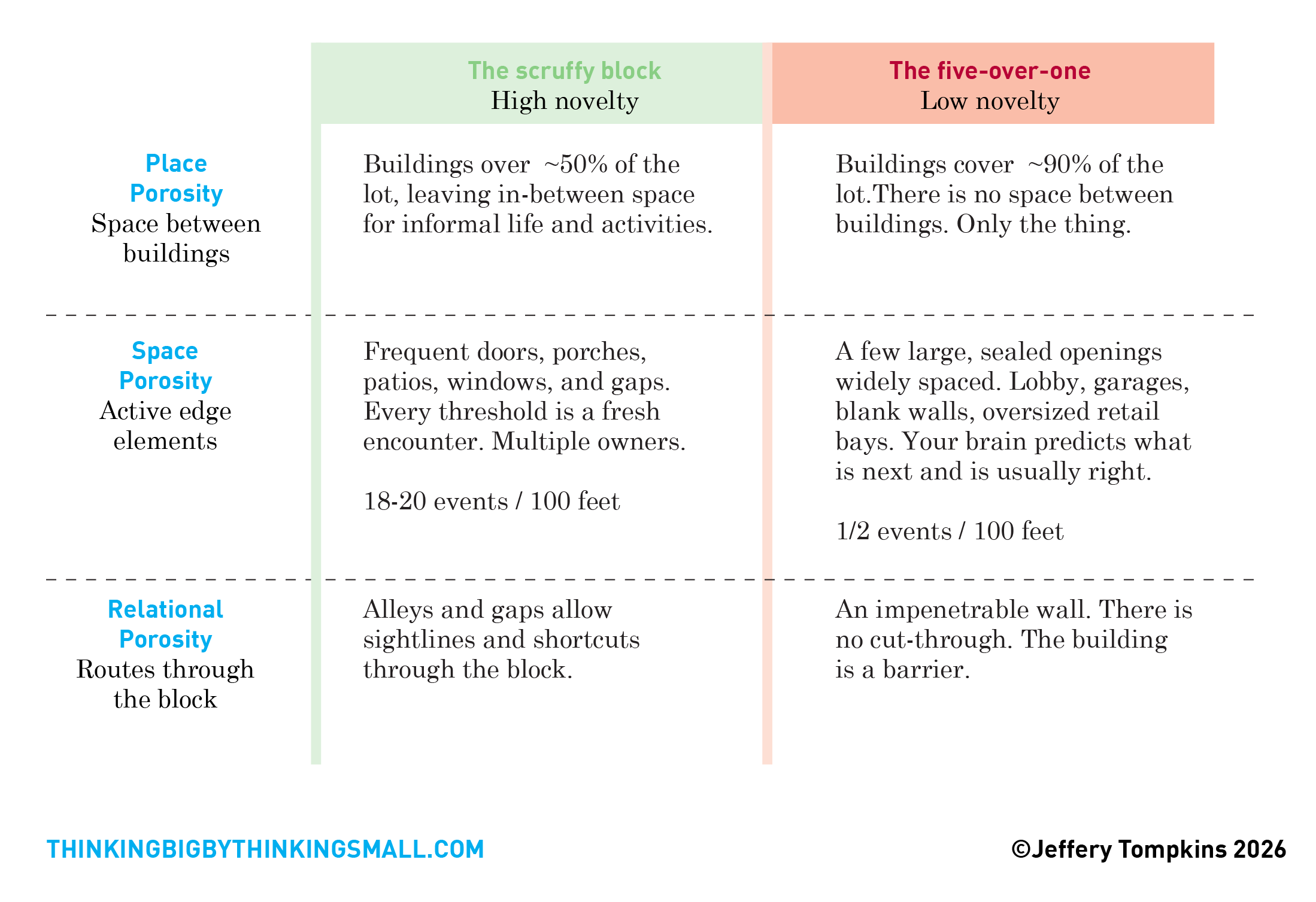
The new development has one building on one lot. The facade changes when the overlay zoning decides it changes (every 50 feet) which is whenever the fiber cement panel shifts from gray to taupe. The building has one owner making one set of decisions about the entire block face. The ground floor serves the building’s internal needs (parking, lobby, leasing) and not the street’s needs. The boundary between inside and outside is sealed. The building presents a surface to the street. The scruffy block presents a membrane. The edge is lame.
In my last article, I used the word porosity to describe this difference. Now I want to make it more specific.
The scruffy block has moderate place porosity: the buildings cover maybe forty to fifty percent of their lots, leaving room for yards, gangways, parking pads, gardens, the spaces between things where informal life happens. The five-over-one has almost no place porosity — the building covers eighty-five to ninety percent of its lot. There is no space between things. There is only the thing.
The scruffy block has high space porosity: lots of active edges and openings in the building fabric at the ground plane. Doors, windows, display surfaces, porches, that gap where the vacant lot lets the sky in. Random flowerpots that grab attention. Active edges are the novelty. The five-over-one has low novelty and thus space porosity — a few large openings widely spaced, most of them functionally sealed (the lobby) or economically failed (the empty retail bays).
The scruffy block has high relational porosity: the alley behind the buildings connects to the next street, the gaps between buildings let you see through to the interior of the block, the lot pattern creates multiple possible routes and multiple possible encounters. The five-over-one has zero relational porosity: the building is a wall, continuous and impermeable, from one end of the block to the other. There is no way through. There is no way around or through. There is only past and forward.
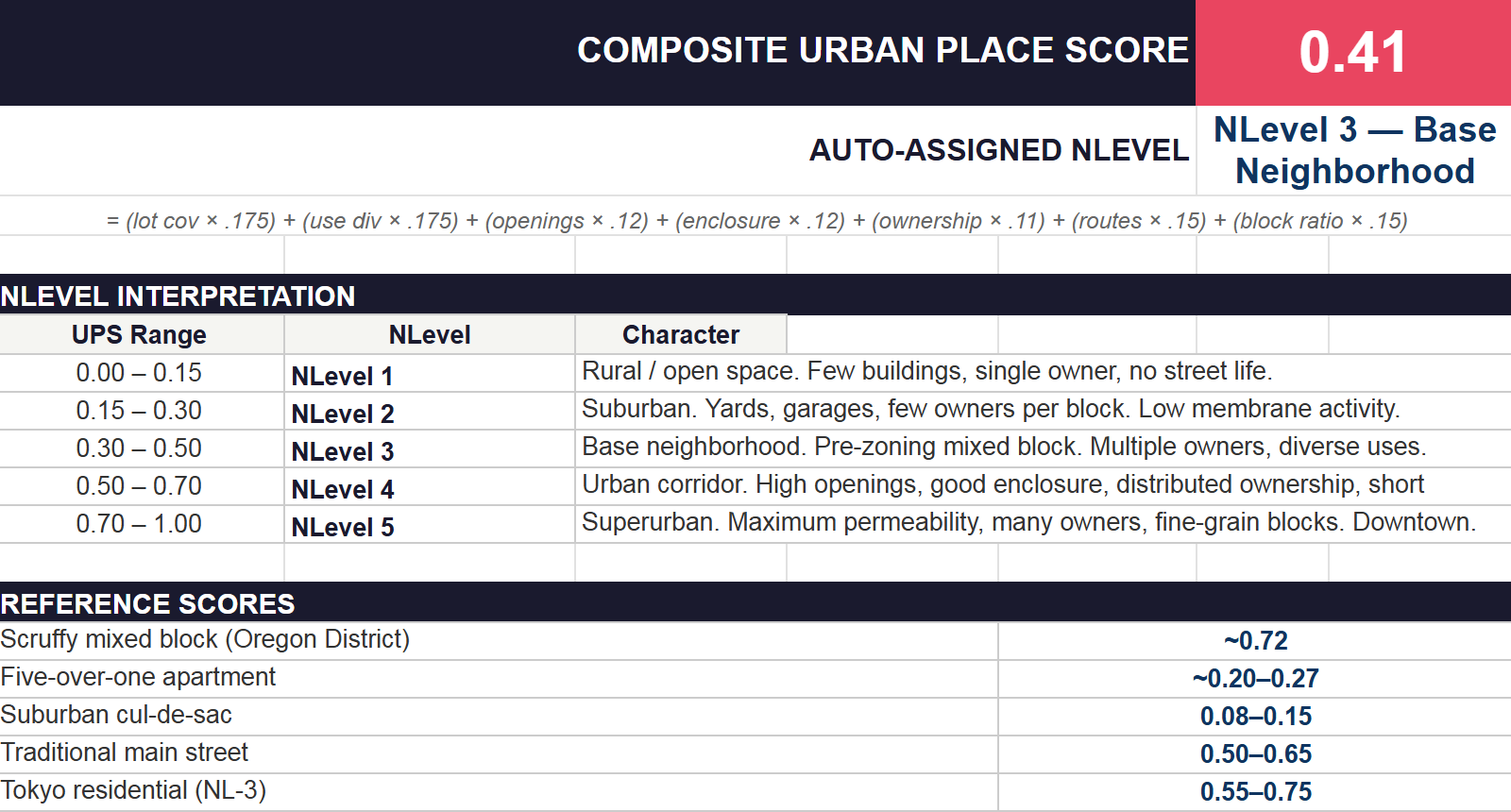
Dense but imporous. That is the diagnosis. Dense, but the novelty is missing.
I’ll ask: which feels more like a place?
I want to be careful here because I don’t want this to read as nostalgia. I am not arguing that we should preserve every scruffy block and build nothing new. We need new housing. We need a lot of it. The five-over-one exists because cities need density and the market delivers density in the form that maximizes return on investment. Good! I understand the economics. I have worked with developers and will continue to do so. I am not anti-development. New development fits a need we desperately have for new housing.
What I am is anti-imporous development. I am against building types that add people to a place without adding life to a place. I am against codes that measure density and ignore porosity, that count the units and miss the opportunity to place plants on a porch. I am against a planning profession that evaluates a building by its compliance with setback dimensions and transparency percentages while ignoring what happens on the sidewalk after the building opens. I am against code that doesn’t let great places happen. I think we can make places feel more alive by understanding and upholding a decent relationship between buildings.
Gehl didn’t count doors because he liked doors. He counted doors because doors are where the inside of a building meets the outside of a street. Every threshold is a transaction between private life and public life. Every porch is a potential encounter. Every patio is an eye on the street, a person coming or going, a reason for someone else to be there. When you replace six buildings with six doors each or thirty-six doors on a block with one building with two entrances, you have not just changed the architecture. You have removed thirty-four opportunities for the street to be alive.
That is what the five-over-one does. It replaces a porous block with an imporous one. It replaces thirty-six transactions with two. It replaces the five-second rhythm with a twenty-two-second silence. And the code, the form-based code, the SmartCode, the transect, looks at the result and says: this is good urbanism. Is it though?
The code is wrong. Not because it is badly written. Because it is measuring the wrong thing.
Next time I’m going to tell you about a country that measures the right thing, a country with twelve zones instead of fifty, where a restaurant can go on a residential street because a small restaurant is not a nuisance, and where the most expensive city in the developed world is also the most affordable of its size.
But before that, I have a homework assignment for you.
This week, walk down a block that feels good to you, but you’re not sure why. It could be a block you like to walk your dog more than other blocks. Take your phone, of course. Count the doors. Count the windows. Count the places where the inside of a building touches the outside of the street. Count the weird things you see that make you linger. Count the alleys, the passages, the gaps, the places where you could turn and go a different direction. Count anything that sticks out as being ‘cool’ or neat to you.
Then walk down a block that feels dead. Do the same count.
You don’t need a planning degree to see the difference. You just need your feet and five minutes. The numbers will tell you everything the zoning map can’t.
This is the second in a series about urban novelty, a new way of measuring what makes neighborhoods work. Last time I introduced the concept. This time I applied it to the building type that is replacing our neighborhoods. Next time: what Japan figured out about zoning that we still haven’t.
Subscribe to follow along. Share this with someone who lives near a five-over-one and knows exactly what I’m talking about.
Next: “What Japan Knows That We Don’t”
This is very good. I am awaiting the description of the zoning code that does this well, especially as recently I am becoming less sure zoning can effectively produce good design given the headwinds against (financing, building materials, etc.)
I do worry that planners and urban designers often focus too much on the first two floors. Yes, they are critical. Yes, eyes head there more. But the upper floors are also visible; too often the buildings are really bland and dull overall.
Great article. I think porosity is necessary but not sufficient to create a great place. To get to the level of granularity and personality imbued on a space that you desire, I think people need to have a literal ownership of the place. Some 5-over-1's give each street-level unit a small porch and a staircase down to the sidewalk but it doesn't make the street all that lively because the people living there have no incentive or are banned from doing any work on it themselves. Jane Jacobs talked about how public housing projects have lifeless streets while privately owned "slums" inhabited by the owners were extremely lively and ultimately well-kept:
"When I saw the North End again in 1959,I was amazed at the
change. Dozens and dozens of buildings had been rehabilitated.
Instead of mattresses against the windows there were Venetian
blinds and glimpses of fresh paint. Many of the small, converted
houses now had only one or two families in them instead of the
old crowded three or four. Some of the families in the tenements
(as I learned later, visiting inside) had uncrowded themselves by
throwing two older apartments together, and had equipped these
with bathrooms, new kitchens and the like. I looked down a narrow alley, thinking to find at least here the old, squalid North
End, but no: more neatly repointed brickwork, new blinds, and a
burst of music as a door opened. Indeed, this was the only city
district I had ever seen—or have seen to this day—in which the
sides of buildings around parking lots had not been left raw and
amputated, but repaired and painted as neatly as if they were intended to be seen. Mingled all among the buildings for living were
an incredible number of splendid food stores, as well as such enterprises as upholstery making, metal working, carpentry, food
processing. The streets were alive with children playing, people
shopping, people strolling, people talking. Had it not been a cold
January day, there would surely have been people sitting."
(Death and Life of Great American Cities)
Porosity is definitely important here, but I think the main effect she's discussing is that a given street in the North End in Boston consists of hundreds of individual owners each contributing their own work and personality to the streetscape and having the full freedom to recreate each building to fit their personal or entrepreneurial needs. This simply won't happen in Public Housing or large scale market rate housing operated by an institution, no matter how porous the built environment is.