


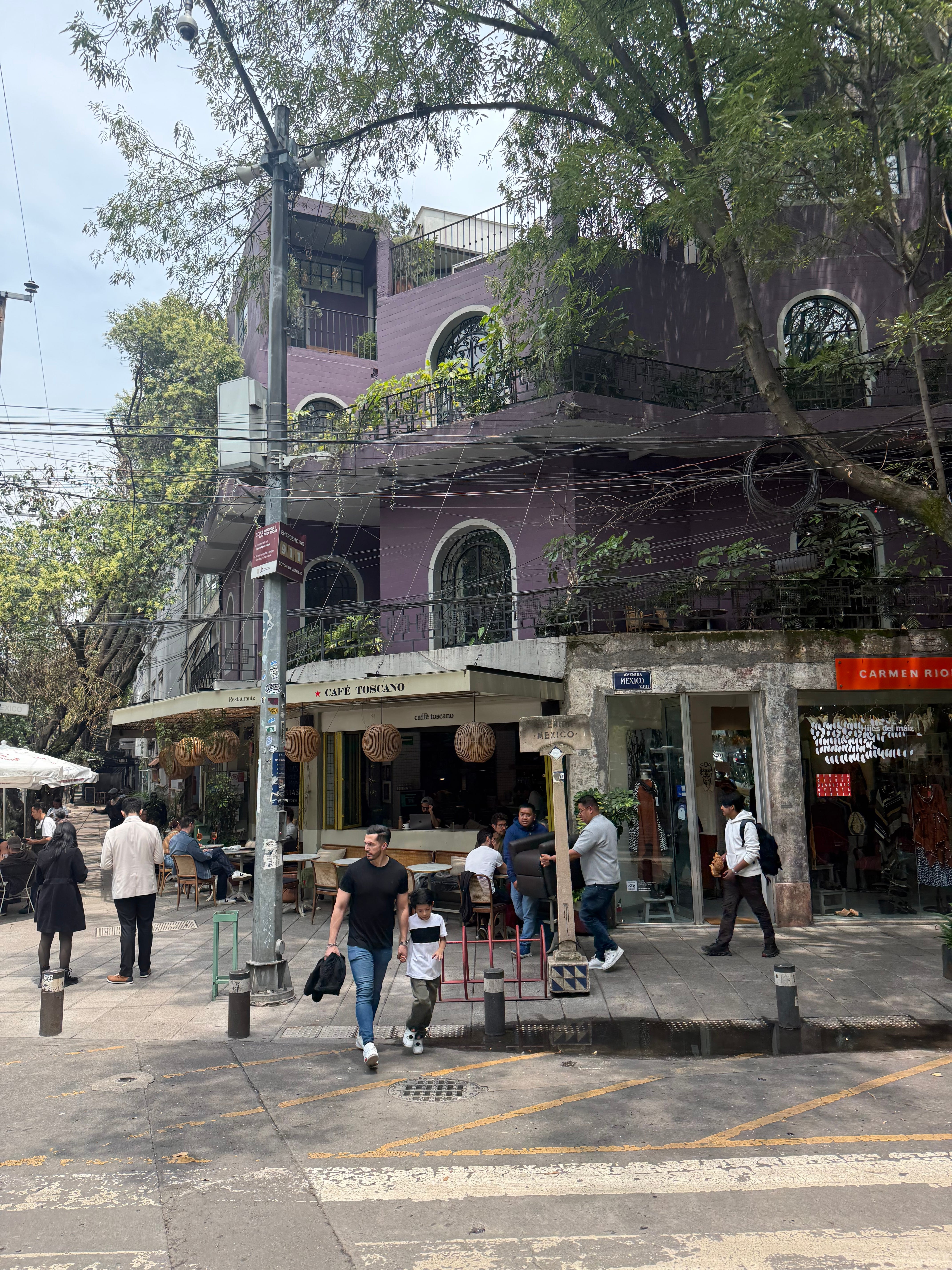
We’re sitting at the corner of Avenida Michoacán and Avenida México in the Condesa neighborhood of Ciudad de México aka Mexico City.
It’s a Tuesday. Three in the afternoon. Buenas tardes. Nothing special is happening.
And yet something is happening everywhere.
One too many spritzers later, an elderly man sits pecking at chilaquiles that have been out too long, unbothered. A ragtag troop of accordion-heaving musicians waltzes table to table, harmonizing for exactly 45 seconds before moving on, a tacit understanding with los propinas. Two young men in tattered, paint-spattered jeans roll a tire into the fenced construction site next door. What could they possibly be doing with that? A small girl on an Ecobici weaves between the tables nearest the tree-lined avenue and the café crowd at Toscano. And yes, someone’s dog is yipping, tied to a parking meter, watching all of this with the calm authority of a building inspector.
The infrastructure hums above, a superfluous powerline cascades to the ground, perhaps shook by a micro earth tremor.
There’s an elderly man selling tamales from a cart at the corner, and the line — four people, maybe five — is blocking the sidewalk just enough that you have to step into the street. You almost collide with a woman on a bicycle who rings her bell at you. Not in anger. Just a warning. You step back onto the sidewalk grinning, because somehow that entire sequence from the close-call to the bell, to the chilaquiles and the yipping dog — it all felt like a conversation you were part of, even though nobody spoke to you.
In that, the scene here at Parque México purrs.
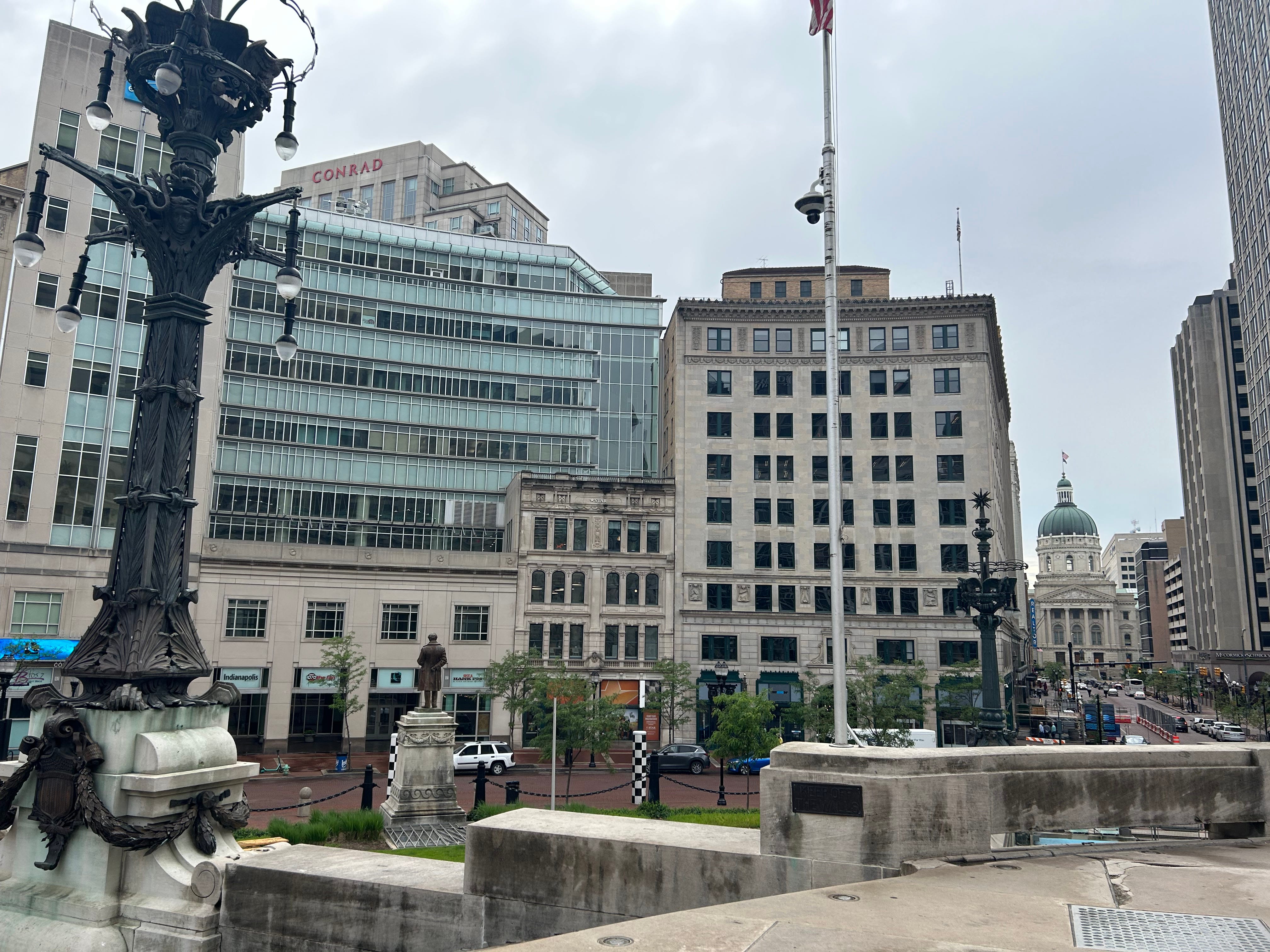
You wake up. You’re in Indianapolis now. Meeting a friend for coffee on Monument Circle.
Grab your latte. Walk south along the Circle to the southern steps. Past some panhandlers under an ornate theatre marquee. There are flyers for upcoming shows but no one outside. Keep going.
The buildings are still here. Most are even taller, but many are the same vintage, the same brick. Many of them are genuinely beautiful, in a way that Condesa’s low-slung stucco never attempted. One is classic Art Deco, its crown stepping back in a nod to the nascent setback laws of 1920s New York. Large, lumbering buildings, some rising sixty stories, pierce the sky. Facades drip with the warm grays of hometown Indiana limestone quarried just dozens of miles away. The architecture is more accomplished than most of what you saw in Condesa. The density, if you measured it by floor area per lot, is comparable to what you just left.
But something has …shifted.
The buildings are pulled back from the sidewalk. The doors are fewer and farther between. No upper floor balconies. Not many plants. Not so many windows or porches, you think. Ground floors are parking garages, blank walls, windows with nothing behind. Lots of glass! The lots are wider, and the blocks are long. There is no dog tied to a meter. There is no tamale cart. There is no woman on a bicycle with a bell yelling to get out of the way. However, there is the beautiful, towering Soldiers and Sailors Monument that pierces three hundred feet into the pale Midwest sky, casting a lingering shadow over a man selling “glizzys” from a cart. A street person yells at a passerby. Neither of them looks up.
The infrastructure is fine, great even. No falling powerlines here.
But for now, there is only you, on your phone now, looking past buildings that are not talking to you, or to each other. The architecture is gorgeous, you think. But does mere beauty not make great places?
At least today, Monument Circle does not hum.
It idles.
It does not go.
There’s Gotta be a Word for It
I have been thinking about cities for awhile now, and for most of that time I have been trying to figure out what makes that difference. Not in the abstract — I’ve read Jacobs, I’ve read Gehl, I’ve read the canon of the New Urbanists and I know the theories. Eyes on the street. The ballet of the sidewalk. The five-second rhythm. I can recite those. What I couldn’t do, for years, was measure the difference. I could feel it. I could describe it. I could walk a client down a street and say “this is alive” and then walk them down another street and say “this is dead” and they would nod because they could feel it too. But I couldn’t tell them why in terms precise enough to write into a code. We both know Monument Circle doesn’t feel like Condesa, but why? It’s not just because of population density. And it’s not because one has tamales and the other hot dogs.
The planning profession’s best attempt at measuring this has been density. We measure dwelling units per acre. We measure floor area ratios. We measure lot coverage. We plot neighborhoods on a spectrum from rural to urban and we call the spectrum a transect, and we write codes that assign each block a position on that transect and regulate what can be built there based on where it falls.
Density is real and it matters. You cannot have urbanity without some threshold of people and buildings in proximity. But density is not the thing I feel in Condesa that I don’t feel on Meridian. Those two corridors have comparable built form. What they don’t have — what is radically, viscerally, unmistakably different — is something else.
I think there’s a word for it.
Take a Walk on the Older Side
Okay, now walk with me for a minute. Not on Monument Circle or in Mexico this time. We’re not going too far away from Indy, though.
We’re in the Oregon District of Dayton, Ohio, ninety minutes down I-70, a city one-fifth the size of Indianapolis, a place that most us Midwesterners drive past on the way to somewhere else. Oregon is Dayton’s oldest neighborhood. The first plat was laid out in 1829, the year the Miami Canal opened and the first boats arrived from Cincinnati, and within a few years German immigrants were arriving by the waterway and building modest brick houses on narrow lots along Tecumseh Street — some of these are still standing. For the next century, the neighborhood grew the way neighborhoods grew before zoning intervened: houses beside shops beside workshops beside taverns, Federal next to Italianate next to Queen Anne, all threaded together on a twelve-square-block grid of brick streets and sometimes gravel alleys. By the 1960s, the city wanted to bulldoze it for urban renewal. A group of residents who understood what they had fought the demolition plan, got the neighborhood listed on the National Register of Historic Places in 1974, Dayton’s first, and began the slow, painfully slow work of restoration. In 2015, the American Planning Association named Fifth Street, the neighborhood’s commercial spine, a Great Place in America.
Stand now at the corner of Fifth and Brown Streets. Look around.
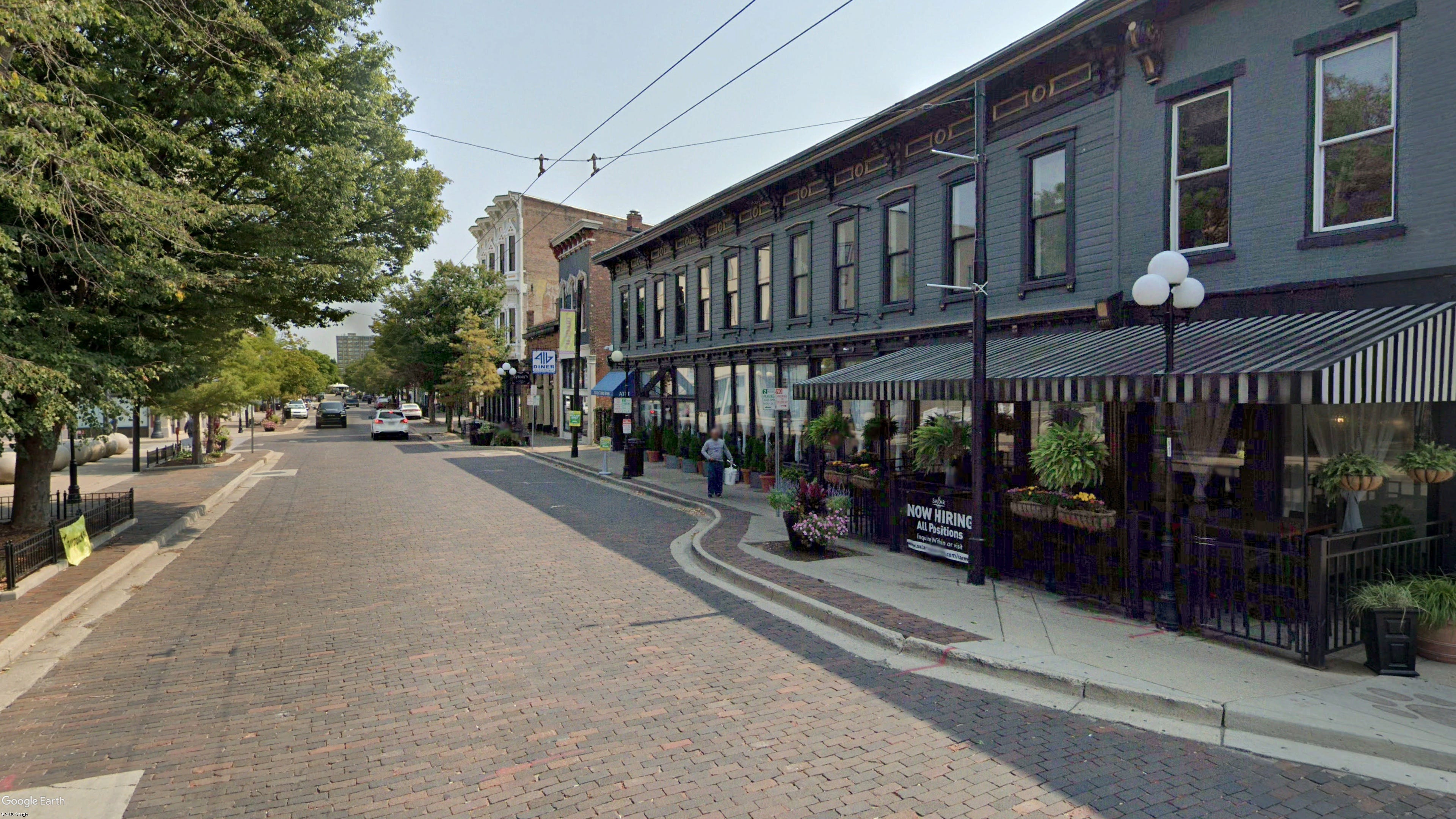
The lots are narrow. Twenty-five feet, thirty feet. Each lot has its own building, and each building has its own front door within arm’s reach of the sidewalk. Some of the buildings are two stories, some are one. Some are brick, some are frame. Most are modest.
Walk one block off Fifth and some of the buildings are both: a barber in what used to be a living room, a tattoo artist in a converted garage, a bar in a building that was almost certainly something else in a former life. The alleys are open and walkable, and you can often cut through the middle of the block to get to the next street over. There are at least six different routes you could take to walk five hundred feet in any direction. On Friday afternoons, the city closes Fifth Street to cars and people spill into the road with drinks in hand: Ohio’s DORA laws let you carry a beer through the district like a civilized adult. Beer in tow, the whole neighborhood becomes, for a few hours, what it was always built to be, an outdoor room.
Now think again about Monument Circle.
This is the big commercial and architectural heart of a much larger city in Indianapolis. Measured by the metrics we use in planning (things like floor area, employment density, commercial activity per square foot) Monument Circle is way more urban than the Oregon District. It has taller buildings. More people working. More money changing hands per acre. By every number in our toolkit, Monument Circle should feel more alive.
But it just doesn’t.
It feels like less like a public space and more like a corporate lobby. You maybe drive there. You park. You go sit outside on the steps. You come out when there’s intentional programming, maybe for the summer farmer’s market. You walk back to the office or drive away. You never quite fully like you are part of a true neighborhood. You never once feel like the place is talking to you. The buildings are not talking to each other. Or to you. The spaces between the buildings are parking garages and five lane stroads, infrastructure for cars, not for encounter.
The Oregon District is modest. Monument Circle is monolithic. Dayton hums in brick and ice cream. The Circle idles in limestone and concrete.
Why?
I’m sure you’ll say density. There’s just not enough people. Condesa and even Dayton’s Oregon District have more people. Okay, sure. But just because a place has a lot or very little people residing in it does not have everything to do with whether it is active. Los Angeles neighborhoods have some of the highest rates of density in the United States while being some of the least walkable.
The answer is not density here. Downtown Indy and Monument Circle have more density than Dayton. The answer is not design. Dayton’s buildings are scruffy, uncoordinated, some of them are arguably ugly, while Monument Circle’s are frankly beautiful. The answer is not mixed use, both places have a mix of commercial and residential activity.
The answer, I believe, is novelty.
Your brain is a prediction machine. It is an algorithm of output-generation based on biological and experiential inputs. It is constantly scanning the environment, comparing what it sees to what it expects, and allocating attention based on the gap between the two. When the environment delivers something your brain did not predict like a fresh face, a new door, a new smell, a different texture, or a weird noise coming out of somewhere, your brain rewards you with a small pulse of electricity. You light up. You slow down. You look. You linger. Neuroscientists call this the orienting response.
Jan Gehl, the Danish architect who spent sixty years counting pedestrians, measured its urban expression: on streets where something new happens every five to seven meters (a different shop, a different door, a different awning), pedestrian activity is seven times higher than on streets where the frontage is monotonous. Seven times over. Not because the architecture is better. Because the novelty is higher. The brain stays engaged because the environment keeps delivering things the brain did not predict. It wouldn’t matter if they were all Hadid or Gehry-designed buildings. It would not matter if they were zoned with a mixed-use overlay. It would not matter if there were neoclassical historic sites.
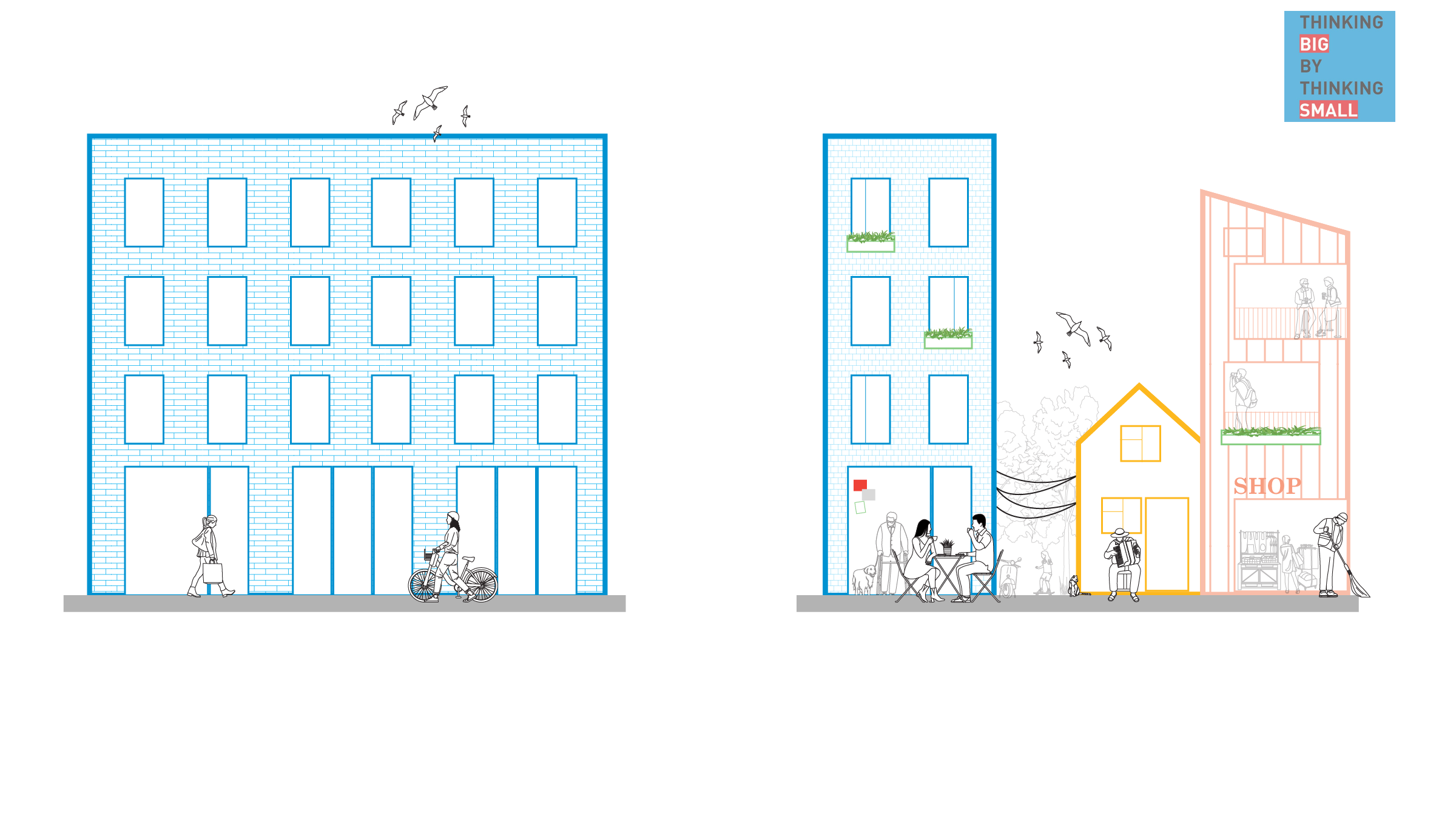
Urban novelty is the rate at which a place delivers new information to a person moving through it. A place with high urban novelty changes constantly at the scale of the human step which means every five seconds, something new. A place with low urban novelty repeats the same wall, the same material, the same sealed surface, for fifteen or twenty or thirty seconds at a time, until the brain gives up, checks out, and reaches for the phone. And we are wont to grab the phone.
Our first scene in Condesa had a high urban novelty; its narrow lots mean that every fifteen to twenty-five feet there is a different building with a different owner, a different door, a different relationship to the sidewalk. Its alleys and paseos and gateways mean you can move through the block in multiple directions, encountering different things on each route. Its ground and upper floors are permeable — doors, windows, display surfaces, outdoor seating, vendor stalls, porches, plantings, music — and the activity inside the buildings spills out onto the sidewalk and the activity on the sidewalk filters into the buildings. The boundary between inside and outside, between private and public, between what’s “yours” and what’s “mine”, is soft. Negotiable. Alive. Every threshold is a fresh encounter. And that’s not just because it may be your first time here. The built environment lends itself to being intriguing. It’s built by incremental hands of thousands. Every block is a sequence of small surprises of humanity’s daily minutiae. The buzz of the place itself is intriguing. It’s novel.
Even with the absolutely breathtaking monument at its center, Monument Circle lacks such novelty. For two of its quadrants, the block is dominated by one owner, with one entrance and one relationship to the street, which is really creates none because the building is monolithic to passerbys. Its orbital road means there is exactly one route for pedestrians. Its ground floors are sealed by lobby entrances, parking structure walls, blank facades punctuated by curtain glass. The boundary between inside and outside is hard. Impermeable. Non-negotiable. Cold. Your brain predicts what it will see in the next five seconds and it is right. It is right again five seconds later. And again. And again. The brain stops predicting because there is nothing left to predict. You are on your phone now.
Opposite novelty. Opposite experience.
So, what produces urban novelty? What is the structural property of the built environment that generates the stream of new information your brain craves?
The answer comes from materials science. In physics, a porous material (like a sponge, a coral reef, a loaf of good bread) is one that is full of openings, passages, channels, and voids that allow energy and matter to flow through it. It allows communication between the outside and in. An imperious material, a block of concrete, a sealed container, a parking garage, is one that resists flow. The energy hits the surface and stops. Porous places have a flow of place (write that term down, we’ll come back to it eventually).
Buildings do this. Neighborhoods do this. Cities do this. The porosity of the built fabric, the frequency of openings in the boundary between building and street, the number of passages through the block, the permeability of the ground plane — is what produces novelty. Each opening is a source of new information: a glimpse into an interior, a sound escaping through a door, a person emerging from a threshold, a smell drifting from a kitchen. The more porous the fabric, the more novelty it generates. The less porous, the less novelty, until you reach the condition of Monument Circle, where the fabric is so sealed that the only new information is the occasional parking garage ventilation slit.
Porosity is the structure. Novelty is the experience.
You feel the novelty. You can measure the porosity. And I believe that measuring the porosity by counting the openings, mapping the passages, quantifying the permeability of the ground plane, gives us a way to predict, with precision, which places will produce the urban novelty that makes a street hum and which will produce the urban monotony that makes a street idle. This is how we can actually measure which places go and which ones don’t.
This is the variable that neither the density calculation nor the architectural review can see. And this is the variable I want to put at the center of how we zone our cities.
That’s a big claim. I’m going to spend the next several posts making the case for it. I’m going to show you what novelty looks like — from Chicago’s Logan Square to Tokyo to even here in humble Indianapolis. I’m going to show you what happens when you measure porosity instead of density and how it reveals things about our neighborhoods that the current zoning map cannot see by default. I’m going to show you what a zoning code built around porosity would look like, and why I think it would produce better outcomes than the codes we have now.
And I’m going to tell you about building types and codes that are being done all over America right now and why they might score well on every metric we currently use and terribly on the one metric that actually matters: novelty.
But I’ll leave that for next time.
Just for now, I want to leave you with this. Next time you’re walking down a street that feels alive (a street that, shall we say, hums) slow down and notice what your body is noticing. Are there many entrances? Are the buildings unique? Are there lots of them? What are the people doing? What does the street look like? How long is the block? How soft is the boundary between inside and outside? Do you wonder where you’ll walk next? Is the hazy rhythm of windows a staccato, or is it a consistent lull? Are the street walls colorful? Are there patios? Do you smile?
Is it a place to be consumed — or is it a place to live?
That’s novelty. And your body has been measuring it your whole life.
Your zoning code has never measured it once.
This is the first in a series of posts about a concept I’ve been developing — a new way of thinking about what makes neighborhoods work, grounded in years of planning practice and observation of cities. If you’re a planner, an urbanist, or someone who just feels the difference between a street that hums and one that doesn’t, I think you’ll find something here. Subscribe to follow along.
Next: “Why the Five-Over-One Feels Dead”
Great observations! I’ve been referring to this as a “fine-grained urban fabric,” but novelty is a much more succinct term. Good point on architecture—Tokyo has some of the best and most fine-grained urbanism, yet all their buildings look like they’re covered in bathroom tiles. It’s one of the reasons I enjoy Parisian suburbs over Haussmanian Paris as well (Vincennes, Puteaux, Colombes, and Nogent-sur-Marne being some great ones). Ultimately, I think a lot of it boils down to whether development retains small-lots with diverse development/ownership. We used to develop/plat like this from day one, why not do it again?
This is brilliant, thanks for writing it! Very much looking forward to the next installment.