


This is part two of an ongoing series on my theory of four-dimensional thinking around cities - you can read part 1 here.
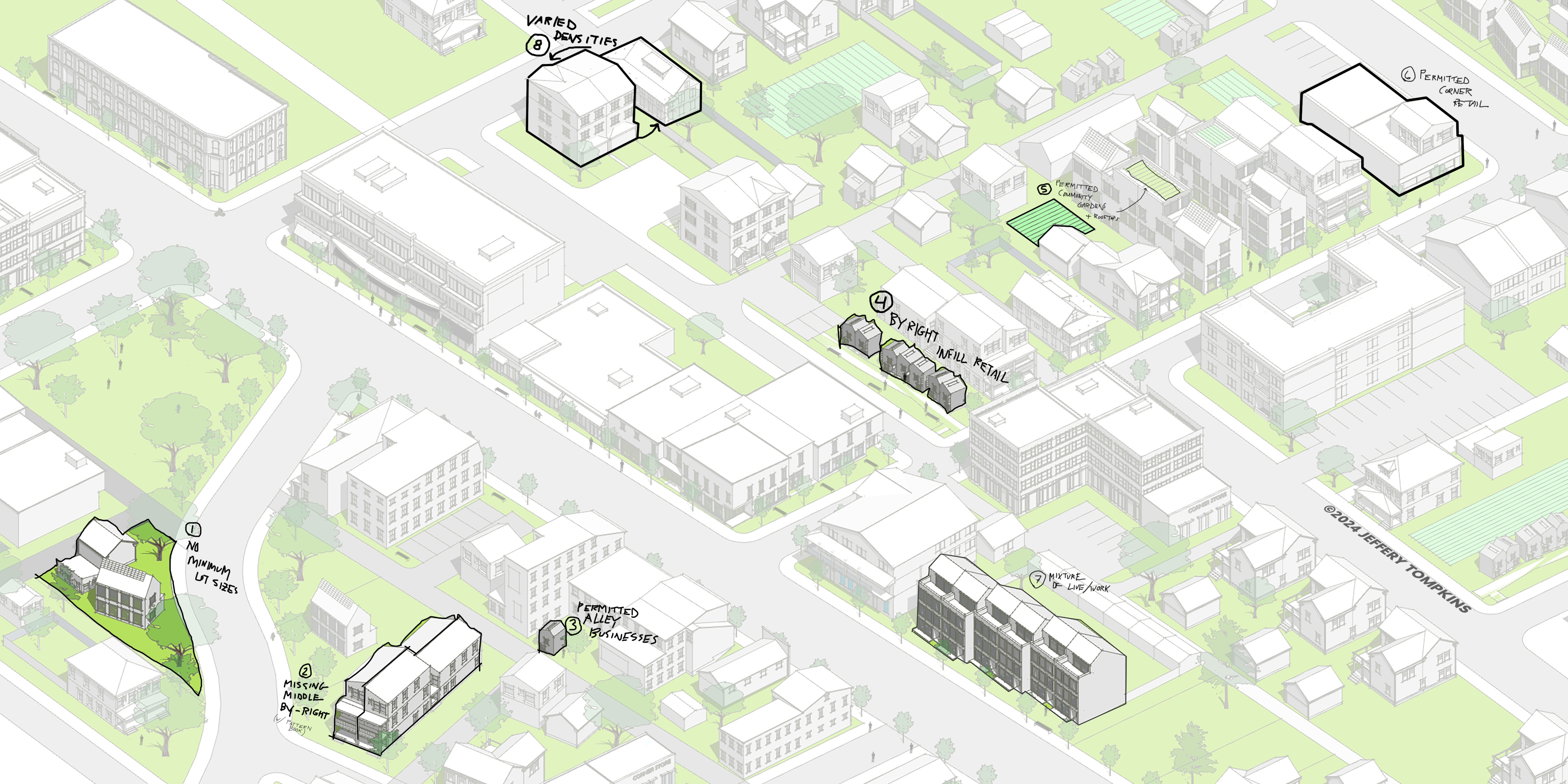
As a concept, Thinking Big by Thinking Small is my attempt to explain the principles of four-dimensional thinking in terms of urban planning and city design. I hope to represent an approach to urbanism that goes beyond traditional planning and spatial considerations which integrates functionality over time. This affords us the dimensionality of intersubjective realities responsible for human actualization – things like meaning, purpose, joy, productivity, innovation, and community.
In essence, “making places go” as an idea seeks to create cities that are not only physically functional and aesthetically pleasing but also adaptive, resilient, and capable of fostering joy, wealth-building, and efficiency through emergent patterns that sustain momentum over time cycles. This is similar to how ants know to follow each other, or a flock of birds flying synchronously without being told. Good urbanism should create a flow of place. And create an order without design. The big question is: how can planning allow such emergence? Planning is inherently a top-down, process-driven procedure, whereas emergent phenomena is bottom-up, spastic, and unpredictable1.
As I have lived in and experienced the built environment throughout my life, I have been curious about what made some cities thrive and others not, even when controlling for amenities, densities, population, and services.
What I have found is a lack of flexibility within the macro-lens of contemporary urban planning that affects the innate ability of cities and places to emerge. My work intersects with how to eschew this paradigm in lieu of empowering individuals to co-create communities with the tools of “good” urbanism. Modern planning processes by definition are slow to adapt and are reactive, rather than proactive, leaving little room for the organic, bottom-up development that fosters real, human places. Because civic vision is often outsourced to consultants, long-term plans occur infrequently and struggle to keep pace with the evolving needs of a place. This results in engagement fatigue and plans or codes that are outdated by the time they’re implemented. And it’s just not as fun as true co-creation. How can we make places sing?
I am fascinated by the seismic shift in urban theory that has increasingly flattened since Richard Florida published The Rise of the Creative Class. Florida’s groundbreaking book (at the time) posits that cities compete by attracting talented professionals with vibrant, “consumable” lifestyles2. With the rise of telecommuting and even more so since the Covid-19 pandemic, we have seen a deeper “flattening” of cities – in a world where work-from-home means workers can work anywhere, places are valued for livability over proximity to jobs and economic activity is increasingly decentralized. Our current models of the city are perhaps outdated3, due to their skewedness toward either spatial or economic schema of the city, and my work hopes to achieve a marriage between increasing hyper locality and dispersed markets in a world where firms are choosing cities based on where employees want to live, not just labor pools. I think the time is now to explore a new model – one of finer granularity within urban scales. One that is both hyperlocal and procedural. One that is flexible and systems-based.
In Western cities, we waste significant resources developing complex strategies for large-scale projects or macro-grain zoning patterns, while neglecting the opportunity to reform parcels or codes to allow for smaller, emergent uses on a meso- and micro- scale that would enable incremental, affordable development appropriate given market and rents4. Eschewing traditional paradigms of granularity, what we allow is inherently macro-scale and expensive, stifling the kind of organic growth that leads to adaptable cities. These are the regulatory structures that have stifled places like Hammond and Gary, even when the macro trends haven’t done them any favors. These are serious issues that encourage trends like displacement as part of gentrification and disallow community gardens due to code violations, for example. Instead, our regulatory environs disallow rather than encourage hyperlocal, community development.
“How do we let places happen?”, then, is the key question of my work.
The Four Dimensions Explained
The chief premise of this philosophy is land use should be for two things: wealth-building and co-creation. This can be achieved through getting small spatial elements dialed in through the four dimensions of planning (place, space, relata) to allow emergent co-creation to emerge. This process emphasizes the dynamic, evolving nature of urban spaces and the complex interplay between physical environments, social relationships, and cultural activities over time. As the dimensions are fractals of each other, they can all play at a micro or macro scale, helping to create multiplicity necessary for emergent urbanism. Each dimension works at the granular (product, or design) and the high-level (process, or planning). In this way, each dimension creates a spatial spectrum of approaches to create more dynamic, emergent places. Our planning processes should unlock these tools to actualize our communities. Each “dimension” must be actualized to order to unlock the next dimension level – much like Maslow’s Hierarchy, basic needs of place need met before actualization (flow of place) can occur.
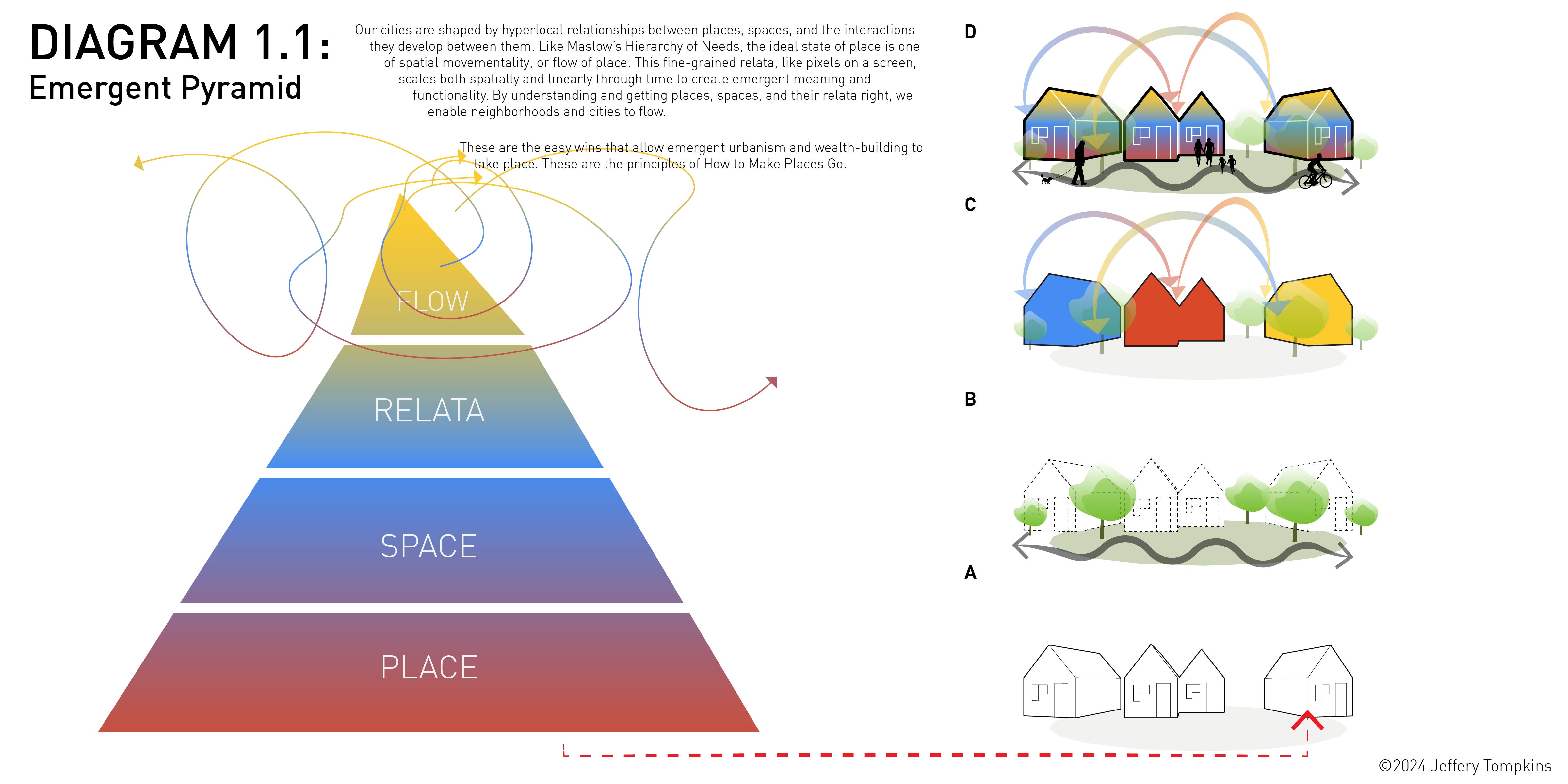
1st dimension: Place – Buildings, workplaces, structures, parks, “the host of nouns, where people could be”
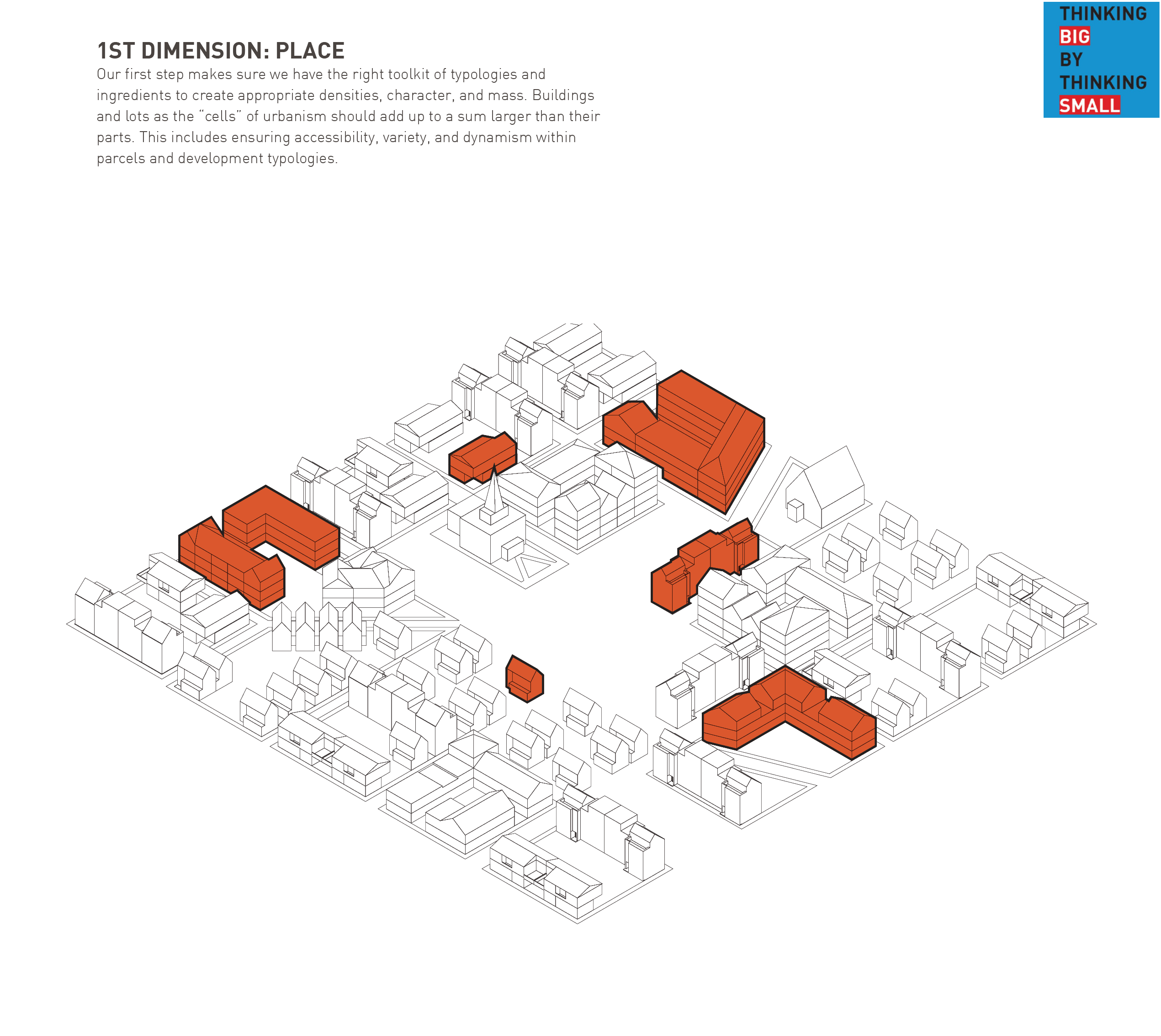
The foundational element of 4DP involves the process of planning, designing, and organizing physical spaces in a way that supports emergent activities. Buildings and lots as the “cells” of urbanism should add up to a sum larger than their parts. This includes ensuring accessibility, variety, and dynamism within parcels (individual plots of land) and neighborhood units. By getting the “easy stuff” right, such as the spatial realm – public-private osmosis, approachability, diversity, and active uses, we set the stage for more complex, emergent urban phenomena to take root. Many of these principles are addressed in movements such as New Urbanism and form-based codes dealing with traditional neighborhood development. But in contrast, they are the first step towards a better urbanism, and not the end result. In this way, the first couple dimensions borrow heavily from these movements, but all of these dimensions push beyond mere form in lieu of prioritizing relationships or relata. First dimensionality of planning should not focus on, overregulate, or place demand based on subjective aesthetics, but rather the relationship of building and lot to the fabric of the neighborhood and the relationships and activities it encourages between people.
2nd dimension: Space – Streets, open space, backyards, patios, “the space between where nouns live, the area between places”
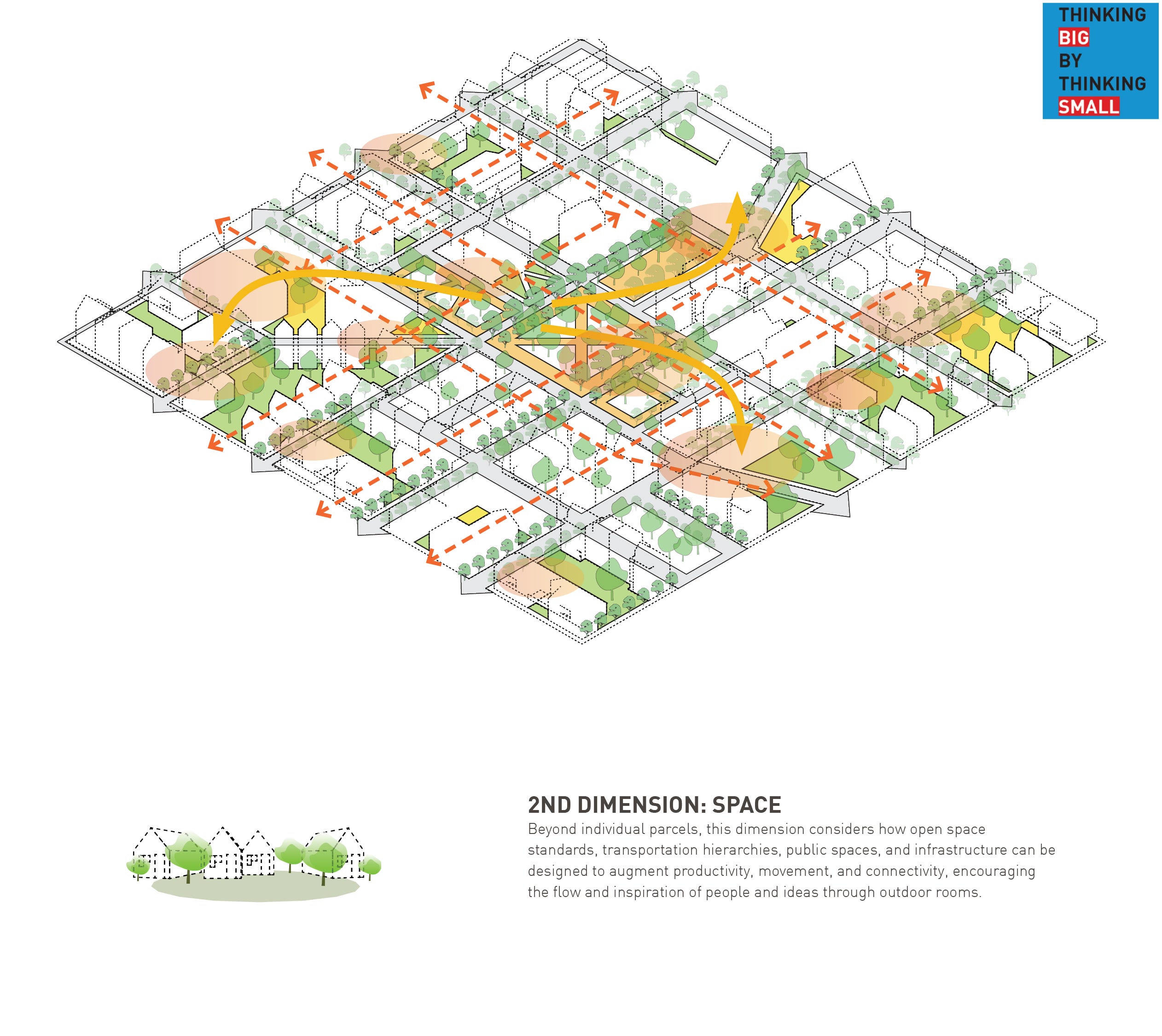
Beyond emergent patterns can form, people have to have places to be and to see. How can planning create an emergent public realm? One that is a place to be. Beyond individual parcels, this dimension considers how open space standards, transportation hierarchies, public spaces, and infrastructure can be designed (or deregulated) to augment productivity, movement, and connectivity, encouraging the flow and inspiration of people and ideas. Many of these principles have been addressed in the work of Gehl (particularly Life Between Buildings and William H. Whyte’s Social Life of Small Urban Spaces.
3rd dimension: Relata – Nodes, zones, urban design principles, placemaking, placekeeping, “relationship between place + space”
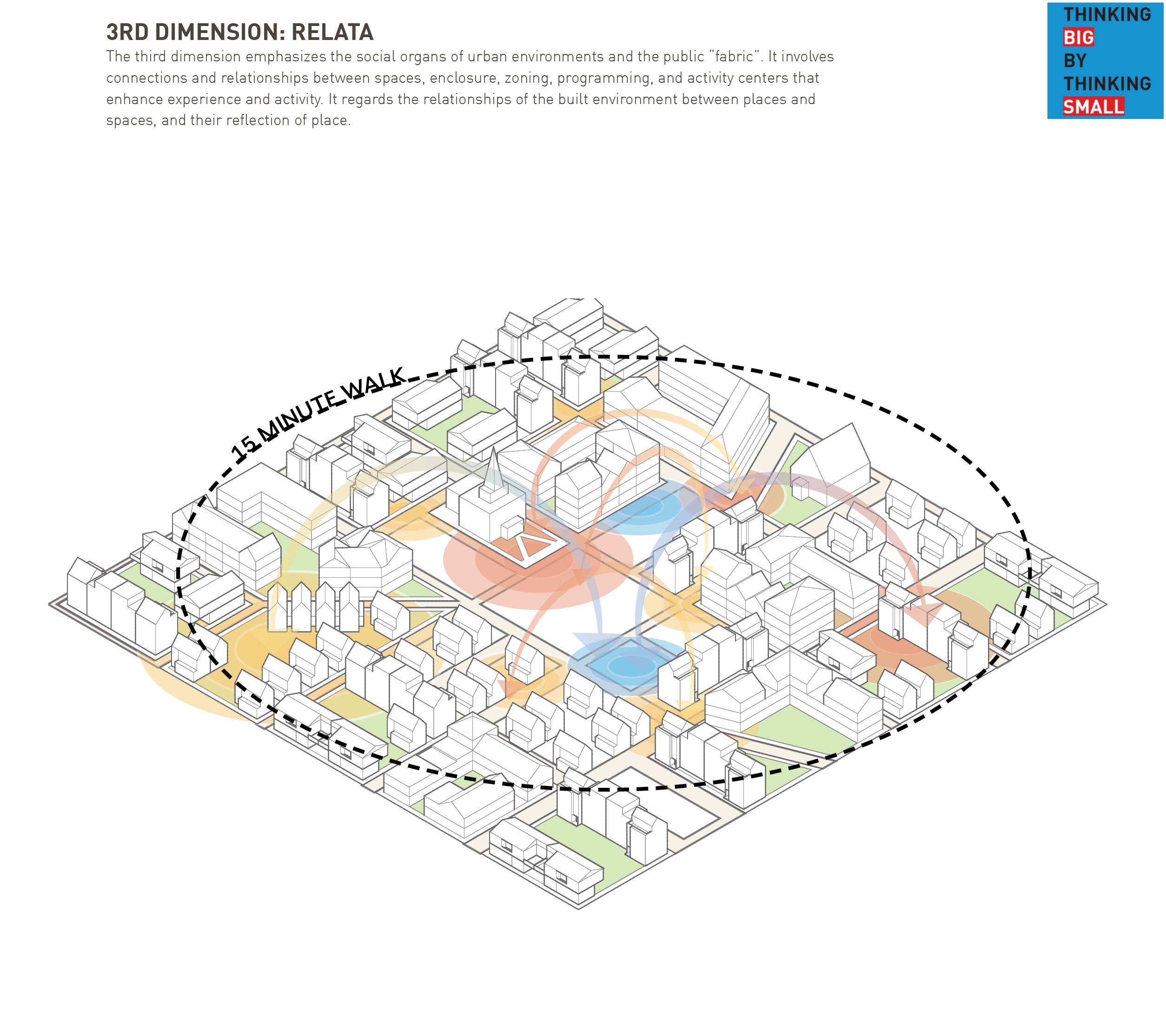
The third dimension emphasizes the social organs of urban environments. It involves connections and relationships between spaces, enclosure, zoning, programming, and activity centers that enhance experience and activity. It regards the relationships of the built environment between places and spaces, and their reflection of place. The third dimension ensures that urban development reflects the needs and aspirations of its inhabitants, promoting a sense of ownership and belonging. This includes the popularly termed “placemaking”, but that term eschews existing placekeeping efforts, maintenance of existing environments, and ongoing change to present places. We don’t create places, places emerge.
4th dimension: Abstract Meaning, Emergence and Co-Creation – Spatial movementality, meaning, purpose, actualization “how space empowers ideas”
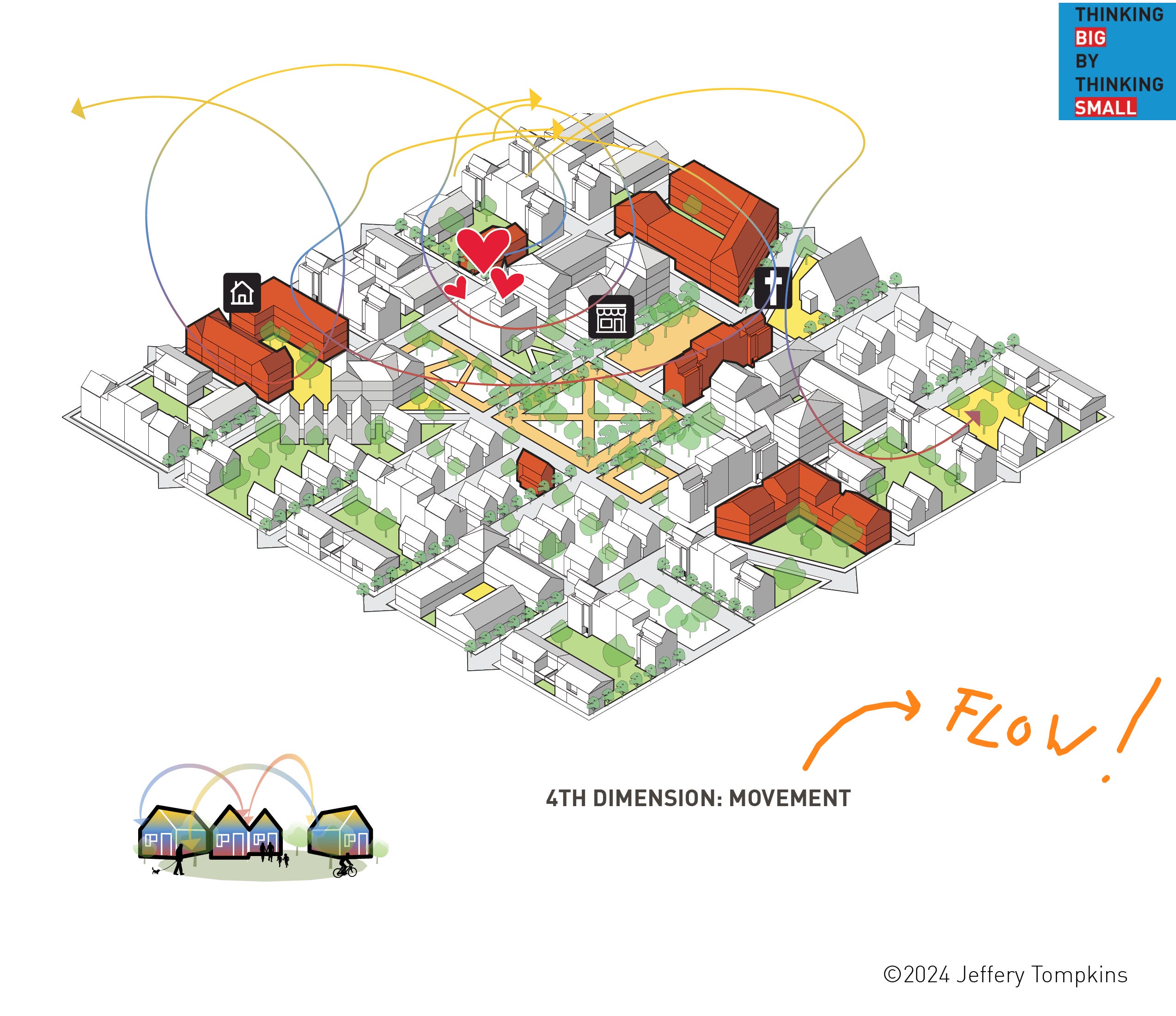
At this stage, meaning, purpose, and actualization can occur for residents in their aim for quality lives. The final dimension or “flow of place” does not require action at all but is the flow of place or “spatial movementality” stemming from proper quality of the previous three dimensions. The final dimension or state forms the emergent properties of urban systems that allow for clustering, innovation, and self-actualization of residents. This dimension acknowledges that cities are not static; they evolve and adapt through the interactions of their residents over time. Both planning regulations on the macro and design elements at the micro should be cognizant of functionality of use over time. As our cities are ever-changing, evolving entities, planners and designers should think beyond mere use. By creating a “petri dish” for complexity through the first three dimensions, where the initial conditions support spontaneous order and innovation, 4DP allows for the organic growth of vibrant, resilient, and joyous urban spaces.
Implementing Four-Dimensional Planning
Implementing 4DP requires a shift from traditional top-down planning methods to a more flexible, bottom-up approach. My work hopes to provide a framework of various ideas, or basic rules, that scale from more concrete (design vernacular or urban design) to more abstract (zoning, spirit of place) that can help us move from designing rigid outcomes to crafting adaptive typologies, flexible codes, and fluid, evolving processes.
In this way, the process outlined in Four-Dimensional Planning (4DP) provides a framework for spontaneous order, creating an active garden for emergence to mitigate bureaucratic red tape, hegemonic corporatism, and inane design review inherent in contemporary development patterns. This is a strategy of getting the first three dimensions of urbanism that can be designed or planned right (place, space, relationships) that foment wealth-building to allow the natural by-product of emergent urbanism, spontaneity, and co-creation (abstract meaning). Planners should take a deep breath, understand what tools are available to make co-creation possible, and deregulate or augment land use provisions to allow emergent activities. This book is an attempt to identify the spatial scale on which these provisions lay in the physical realm in order to suggest strategies and approaches to enact better, hyperlocal places (emergence). This process follows a continuous and responsive time cycle between context, process, and product, acknowledging the planning principles, design principles, and contextual principles along the way that help shape the four-dimensional, hyperlocal city.
In an era defined by rapid urbanization, shifting demographics, and corporate development, emergent urbanism stands as an alternative pathway for places to co-create outside the bounds of regulation, formality, and corporatism. Through their flexibility, the approaches outlined in this book (aka blog) can help redefine our neighborhoods as flexible, living and breathing places, offering a glimpse into the future of sustainable, resilient, and dynamic communities.
We should urge planning to embrace a more organic approach to urbanism. I advocate for cities to evolve naturally, with planners serving as facilitators rather than controllers, acknowledging the limits of their ability to dictate urban life. This would be a paradigm that recognizes the importance of little things, small details, and emergent complexity in creating vibrant, resilient cities. By focusing on place, space, relationships, and abstract meaning, Thinking Big by Thinking Small provides a framework for building urban environments that empower individuals, foster community, and support sustainable growth. Through this approach, we can create cities that truly reflect the needs and aspirations of their inhabitants, offering a path towards more joyous, wealth-building, and efficient urban futures. By embracing these principles, everyone from urban planners, local leaders, neighbors, residents, business owners, and developers can create cities that are not only more functional and efficient but also more joyous and wealth-building. This approach aligns with the understanding that the most vibrant and resilient urban spaces are those that emerge organically through the collective actions of their residents, rather than being imposed from above. It’s combining top-down systems with what can allow emergent meaning. Best of both worlds, if you’re into platitudes.
While many of the solutions are seemingly design-oriented, the process is planning-oriented and qualitative, this functionally offers less prescription in terms of use and form and more prescription in terms of function and relationality of urbanism elements.
We’re going to get to some of these ideas …soon.
But first, I am going to provide thoughts on why rethinking the city and planning is needed. More on that next week »
Combining top-down planning with emergent dimension may be similar to the universal field theory attempts in physics to combine relativity and quantum mechanics, two disparate fields of understanding (both valid and yet unable to be combined in a simple formula). This struggle is more clearly explained by Columbia physicist Brian Greene in The Elegant Universe.
It’s interesting to see the capitulation away from some of his original posits in Florida’s more recent work, including the The New Urban Crisis. The Covid-19 pandemic and its resetting of work commuting patterns will be felt for a long time, and while talent centers of “superstar cities” will still exist due to effects of agglomeration, generally speaking with the rise of work-from-home, workers can be anywhere. This has downward effects on the thesis of Florida’s early work.
Particularly the Bid-Rent Model frequently shown in planning school (much better articulated by Alain Bertaud in Order Without Design). Our cities are increasingly become multi-polar and hyperlocal, eschewing the diminishing land values away from conventional central business districts.
A great note on this is the essay “Mexico City’s Eclectic Apartment Architecture” by Daniel Gordan in the 2025 anthology Messy Cities.
**As a general note throughout this blog, I make no money off links to other publications or books, but every book is one I have read and recommend. : )