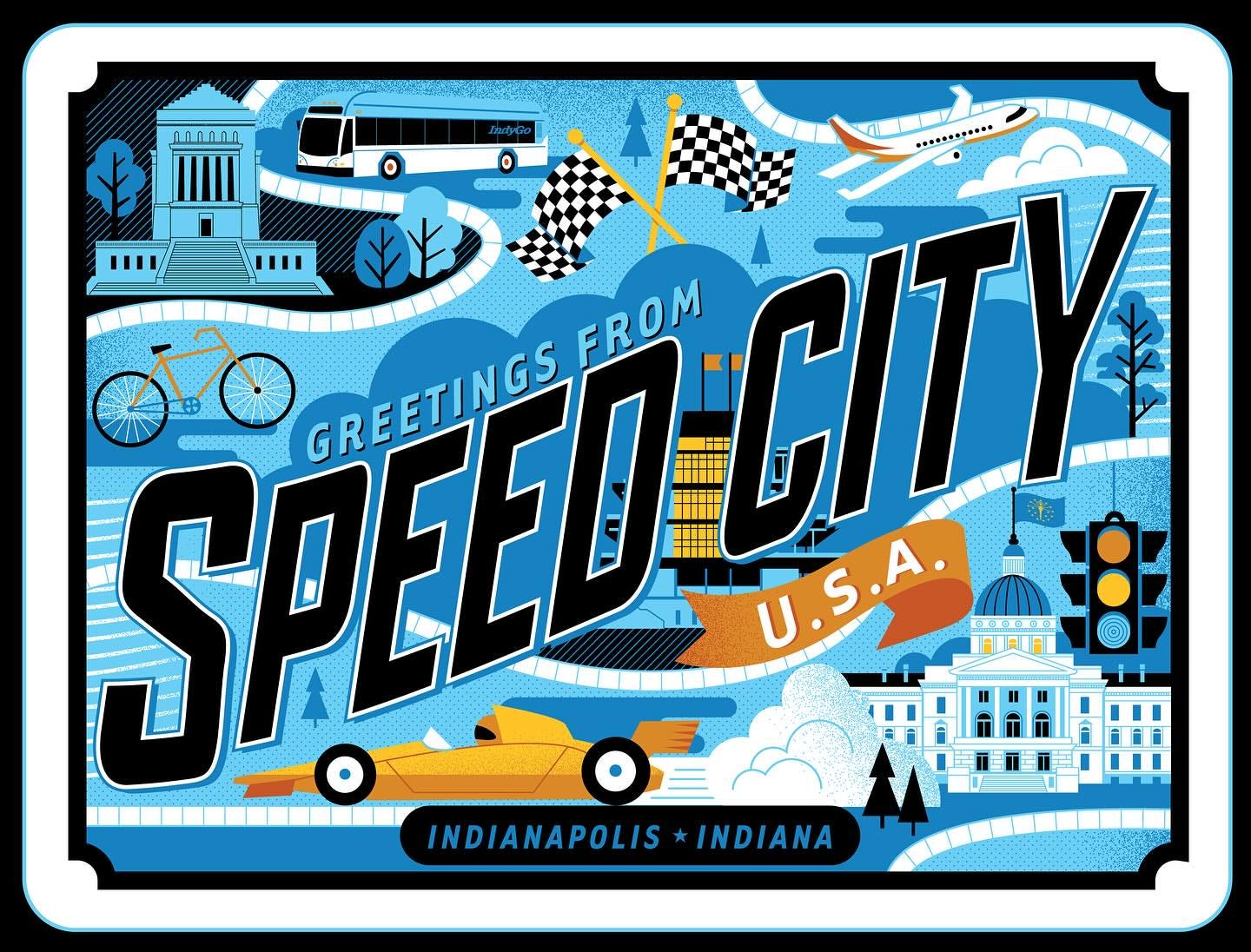
Welcome to Speed City
Indianapolis's new branding strategy can be a winning one. But we have to imbue it as part of our culture.

While my jury is still out on whether AI will vibe-code us into biological extermination or deliver a robust universal basic income on the back of mass automation, I suppose some of us should still be thinking about what civic strategy looks like in the near-term 21st century city.
Apologies for the hiatus. I've been a bit busy getting profiled by the IBJ, launching a district vision plan for Indiana's largest cultural district, and kicking off two other neighborhood plans with Proformus . Add in a string of grant applications and it's been a busy start to 2026. That's a good thing. As someone once told me, it's better to be busy pushing the rock up the hill than aware of your distance from the top. Or something like that.
Alongside my Q&A profile in the Indianapolis Business Journal was a story about the new campaign to rebrand Indianapolis as "Speed City". I've been thinking about this over the past weekend, and while I love the moniker and the energy behind it, I believe it's going to take coordinated municipal and institutional effort, well beyond the convention bureau and the chamber, to make it stick.
Why Austin and Nashville Took Off
The reason cities just outside our peer tier (places like Austin and Nashville) have succeeded has a lot to do with their relationship with their surrounding state. Largely pro-business, conservatively regulated state environments have set the table for blue bubbles that carry the best parts of both sides. (A really good piece here that discusses Nashville in particular). That matters, because most of America leans purple, and a place that feels politically navigable is a place people will actually move to. But the rise-of-the-rest story in Austin or Nashville isn’t just politics. It’s the pairing of major research institutions with that pro-business environment. The agglomerative effects of concentrated talent surrounded by progressive civic culture but light-touch regulation leads to more startups, the emergence of indie music scenes, and in some cases, genuine cultural uniqueness.
So if we’re following the Austin-Nashville playbook, step one is blue dot in a red state, and step two is research institutions, the larger play is culture. And that’s where Indianapolis needs to push if the Speed City title is going to work long-term.
The Culture Gap
What separates Nashville from Indianapolis or Columbus is cultural cache. In Nashville’s case, “Music City” isn’t merely a slogan but covers a lifestyle brand. We connote Nashville as much with bachelorette parties on Broadway and hot chicken as with the country music industry itself, without even mentioning the TV show with the city’s namesake. Austin claims “Live Music Capital of the World” and hosts UT Austin. There’s a culture around the Texas flag, around SXSW, around keeping it weird. Charlotte has the ubiquitous 1990s Hornets jacket. There’s a cool factor these places have cultivated or have at least allowed to emerge.

Indianapolis has the 500. And the 500 is genuinely the Greatest Spectacle in Racing. But it also carries a bifurcated connotation. Racing in Europe evokes F1 playboys in Monaco. In the United States, it’s often attributed to tailgaters throwing beer at a poster of Jeff Gordon. There’s a perception gap we have to lead through, not around.
Speed City Has to Mean More Than Racing
This is why the “Speed City” branding cannot be just about motorsport and why the idea of it is so compelling when you push it further. If Indianapolis becomes the place where innovation happens fast, where builders can build, where founders can found, and where neighborhoods can grow organically without the friction that bogs down other cities then that’s a place that grows a reputation on its own. You didn’t move to Indianapolis because of the Snake Pit. You moved here because it was faster to start up and without the penalty of other places. It’s Speed City, baby!
It’s an Indy minute, not a New York one. And we can go the distance. Well, 200 laps or 500 miles at least.
What the City Needs to Do
But this is ethos-meeting-branding that requires local leadership, both civic and institutional, to step up. At the municipal level, governance should make it as painless as possible to build here. Pre-approved housing pattern books are a good start, but that also means cleaning up a zoning code that runs over 700 pages. It means bringing the permitting process down from months to days. It means promoting a safe, healthy public realm that doesn’t alienate people who want to move fast. This means locking up and strongly prosecuting repeat violent offenders who make our streets dangerous to walk on or take transit with.
Speed City means prioritizing investment in mobility of all kinds: clean, safe, paved roads. You can’t go fast with potholes. How we balance funding to hit those goals should be a priority of any future administration.
What the Institutions Need to Do
On the institutional side, Speed City means breaking down the silos between major employers like Lilly and Cummins and the educational powerhouses of Indiana University and Purdue University. The new uncombined-but-still-sharing-the-same-corner-of-downtown campuses of IU Indianapolis and Purdue Indianapolis should operate the way Vanderbilt does in Nashville or UT does in Austin. These are major research institutions that provide a pipeline to serious employers doing serious work on an international level. Purdue’s current push to build a true urban campus treated no differently than West Lafayette is a step in the right direction. IU now needs to stop treating IU Indianapolis as Bloomington’s B-team. And the two together should foster a research environment where good ideas take off fast.
You go to Indy for school. But you can also take off here.
Because here’s the thing. In superstar metros like NYC or San Francisco, regardless of the field there are countless young, passionate people doing the most they can to get ahead of the rest. Here in Indianapolis, we do not have that ecosystem …yet. Which means if you are young and passionate about something here, depending on the field, you could be on the ground floor and get ahead or get promoted quite quickly.
Now that’s Speed City.


