
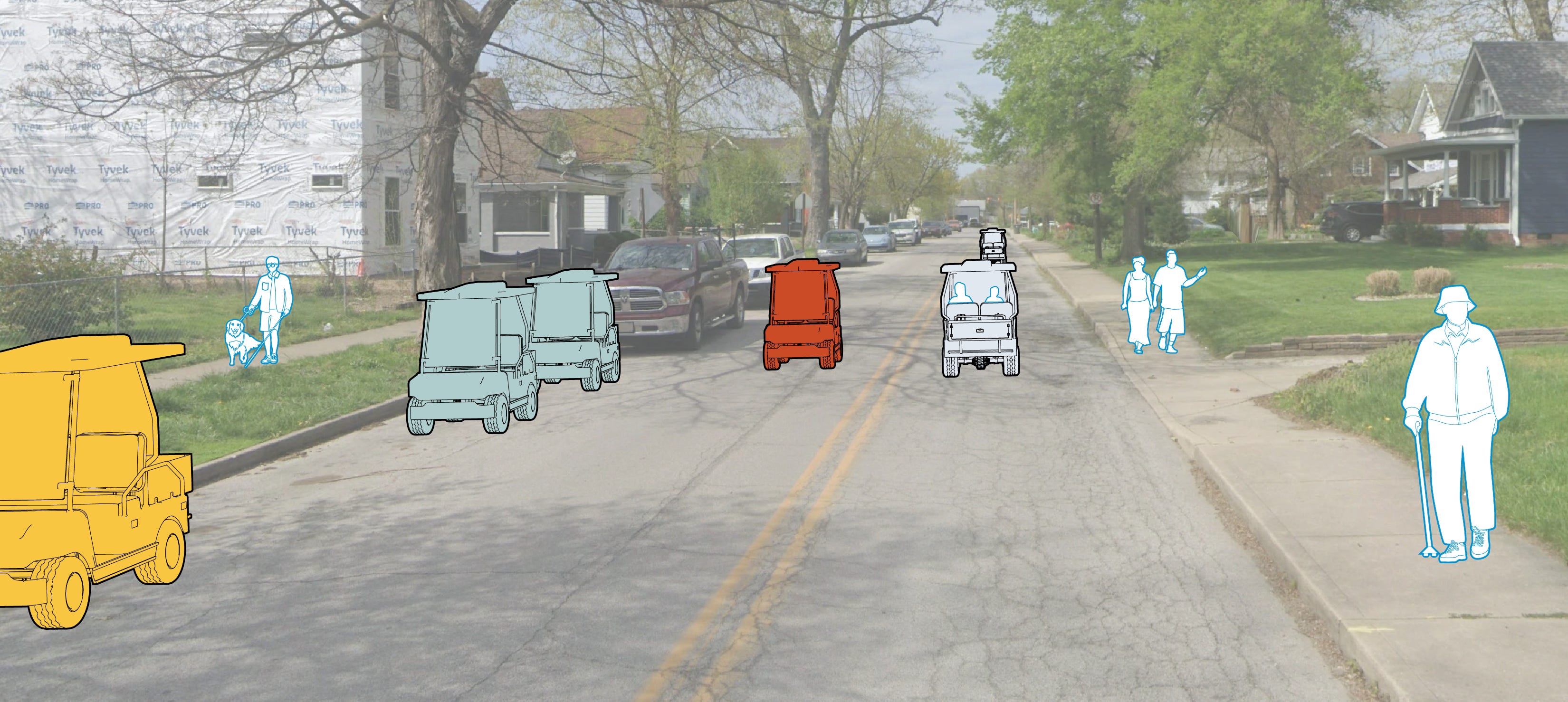
The Cart Test™
A stupid-sounding heuristic for whether you’ve built a real place. We can think big by thinking cart instead of car.
The first time you watch a teenager drive a golf cart to high school in Peachtree City, Georgia, your brain has to do some work. You are looking at something that should be a punchline elsewhere: a leisure vehicle on a public road, an adolescent at the wheel of a contraption engineered to ferry sunburnt retirees between fairways. But, if you keep watching, you may slowly understand that you are also looking at one of the more functional pieces of suburban infrastructure in the country. Peachtree City built itself around 100 miles of multi-use paths in the 1970s1, and the cart became a kind of consequence. Kids commute. Adults run errands. The grocery store has a cart parking lot.

It looks like a joke. It’s not.
I want to propose a heuristic, with full awareness of how silly it sounds: a place is probably well-designed if you could safely drive a golf cart in it. Not because carts solve anything, but because every condition that makes one useful (like calmed speeds, short distances between things worth going to, connected paths, an environment pleasant enough to traverse while sitting exposed to it) is independently a condition that makes a place walkable, bikeable, and humane.
The cart is a kind of canary. It can only survive where humans can.

The EV Revoluton was already here, bruh
Drive an hour out of a metro like my own Indianapolis in almost any direction and the test fails completely. The arterial roads run at fifty miles per hour; the gas stations and the subdivisions and the dollar stores are choreographed for windshield viewing. You could not drive a golf cart to the Kroger if your life depended on it, which in some statistical sense it does for some folks. The Midwest knows how to build small towns that pass the cart test and plenty of Indiana courthouse squares still would, but we have not built much of that since the 1920s.
The American places that did keep building it are revealing in their novelty.
The Villages, Florida, is perhaps the most famous: a planned retirement community of 140,000 stitched together by more than 750 miles of cart paths, cart tunnels under highways, cart drive-thrus at restaurants. It is easy to mock and harder to dismiss the design lesson underneath. Residents simply do not need cars for most daily errands. The cart is not a charming eccentricity there, but it is a functional infrastructure, the way bicycles are in Amsterdam or cars are everywhere else.
Lakes of the Four Seasons (a gated community) in Northwest Indiana is one of the largest private subdivisions in the country. Over 7,000 residents in two counties utilize low-speed streets to circumvent a chain of lakes and homes. No sidewalks, but, who needs them when the streets are all low-speed?

Peachtree City, the model that predates The Villages and gets less attention than it deserves, is not a retirement enclave but an actual mixed-age town where roughly 11,000 carts are registered and high schoolers learn to drive on the paths before they ever touch a steering wheel on the road.
Then there are the geographic accidents: Catalina, Mackinac, Fire Island. Places where cars were restricted or banned because of where they sit, and the cart-shaped void was filled with cart-shaped vehicles. These places are also, almost universally, the kind of place a person will spend money to visit. The correlation is not exactly subtle. These places pass the Cart Test™.
The legal enabling that’s also already here
Underneath all of this is a regulatory architecture I had not appreciated until I started looking. In 1998 the National Highway Traffic Safety Administration created a federal vehicle class called the Low-Speed Vehicle, any four-wheeled vehicle with a top speed between 20 and 25 mph. LSVs must have seat belts, headlights, turn signals, and a VIN, which puts them in a strange middle space: more than a golf cart, less than a car, legally distinct from both. A subset known as the Neighborhood Electric Vehicle was the dream of 1990s planners who imagined whole suburbs converting.
Federal law lets states allow LSVs on any road with a speed limit of 35 mph or less. States can raise that ceiling (some have pushed it to 45) or lower it. Local ordinances then write themselves on top.
What this means, practically, is that your state’s LSV speed cap functions as a legal definition of what counts as a human-scale street. A road posted for 35 mph is one a teenager in a glorified golf cart is permitted to share. A road built for 50 mph is one we have collectively decided is too dangerous for anyone in anything smaller than a sedan. We have written the cart test into law and then forgotten we did it.
Here in Indiana, the state-level framework is Indiana Code 9-21-1-3.3, which lets "a city, county, or town adopt by ordinance traffic regulations concerning the use of golf carts or off-road vehicles" on highways under its jurisdiction. The state itself doesn't broadly authorize cart use; it punts to localities. Golf carts cannot be registered in the state of Indiana, but cities may allow their use on public roads, and you have to check with your local jurisdiction. On Indianapolis specifically: there is no Marion County ordinance that authorizes golf carts (this is confirmed by reports ofHOA notices going out to residents telling them to stop). Knox, Indiana requires a city permit sticker, and Noblesville adopted a golf cart-friendly ordinance in January 2018 allowing carts on city streets within certain subdivisions and neighborhoods. Goshen, South Bend, and Madison all have ordinances; carts are typically limited to streets with a speed limit of 30 mph or less.
Every cart community of any seriousness has done the work of stitching this patchwork together: municipal ordinances permitting carts on streets, dedicated paths owned and maintained by the city, registration systems, sometimes even cart licenses for minors. It is genuinely impressive civic infrastructure dressed up in the most undignified vehicle imaginable.
What about cities, though?
If the suburban version of the cart test produces Peachtree City, the urban version produces something called Circuit, an electric cart shuttle that operates in Asbury Park, San Diego’s Gaslamp Quarter, Fort Lauderdale, and a growing list of downtowns. The carts are free or nearly so, hailed by app, and they solve the last-mile problem in dense cores where parking is bad, Ubers are expensive, and distances are short.
You see them and the same thing happens that happens in Peachtree: a moment of what is this, followed by the recognition that the shuttle is both a symptom and a reinforcement of a place trying to be human-scaled. The cart cannot exist on a stroad and refuses to. Where it appears, conditions have already softened to make room for it.
But it solves the problem quite nicely.
It is worth noting that most of the world figured this out long before American suburbs made it strangely cool. Italian hill towns thread Piaggio Apes, three-wheeled cart-truck hybrids that have been delivering produce since the 1940s, through streets that predate the wheel. Japan has its Kei cars, an entire tax and regulatory class for tiny vehicles that suit tiny streets, a culture of rightsizing the machine to the place rather than the reverse. The Dutch built woonerven, shared streets where cars exist but creep at cart-like speeds because pedestrians and children technically own the asphalt. China has produced an enormous, mostly invisible-to-Americans market of low-speed EVs serving small cities and rural towns. Greek and Spanish island taxis are basically carts with a license plate.
The Midwestern thought I keep returning to is that the cart is simply a reinvention of something most cultures have always had: a vehicle scaled to a street scaled to a body.
Recently, as we visited my partner’s family in downstate Michigan, we took our trips to town from the lakehouse around the lake in a golf cart and it made me think: why the heck not in my own neighborhood?

Where the test breaks
A reasonable objection: cart communities can still enable sprawl. Sure. The Villages is, at the end of the day, a sea of single-family homes around golf courses, with all the ecological and social baggage that implies. Golf also carries some classist baggage. I’ve personally never golfed in my life - we grew up far too poor for that. Cart culture in the US is age-coded and often class-coded; the test can pass for shallow reasons. Weather makes it impractical in much of the country for half the year. Most importantly, the cart is a private vehicle, and a place full of private vehicles, even small electric ones, is not the same as a place built for people on foot.
All of this is true. The defense is narrow becasue the cart test is not a prescription, it is a diagnostic. It does not tell you the place is good. It tells you the place is possible, that the speeds and distances and connections are within range of being good. Failing the test is more informative than passing it. A neighborhood where the cart would be suicide is one where a child on a bike is also at risk, where an elderly person without a license is stranded, where the design has foreclosed everything except the full-sized car driven by a full-grown adult.
Granted, on the flip side, if everyone in your neighborhood started driving a golf cart today to run errands, go to the dog park, etc. wouldn’t that in effect make the streets naturally slower and more human-speed?
Test, test..
Next time you visit a new place, whether a new ocean-sire resort or a town you are visiting on a long weekend, ask yourself:
Would I let a fourteen-year-old drive a golf cart to pick up a pizza here?
The answer compresses speed, distance, mixed-use, connectivity, and pleasantness into one single intuitive image.
The places that pass the Cart Test™ tend to be places people can love. The places that fail it tend to be places people just endure. The reason this is true is not really about carts at all. It is about whether the built environment has any room left in it for a person who is not encased in a ton of steel doing forty-five.
I’ll just say it:
I think we should build more communities where it feels safe to drive a golf cart.
From Wikipedia: In 1974, after the city petitioned the Georgia General Assembly to amend existing laws regarding motorized cart use on city streets, Governor Jimmy Carter signed legislation exempting carts from inspection, motor vehicle registration and certain other equipment requirements for motor cars.[6] This legislation paved the way for the legal use of golf carts in Peachtree City. Since then, the city’s network of multi-use paths has steadily expanded, now encompassing over 100 miles (160 km) and serving as a key feature of local transportation.
Ha, proof that policy can shape behavior!


