


We’ve seen the "back-to-the-city" movement play out successfully for our downtown cores and the historic bones of our inner-ring suburbs. But for the working-class neighborhoods adjacent to these revival zones, the story is more complicated.
For decades, the dominant narrative of housing development has been one of outward expansion or large-scale, capital-intensive redevelopment. While these models have produced housing units in inner cities, they have often done so at the expense of neighborhood stability and without offering a pathway for existing residents to participate in the economic upside of their community’s appreciation. And most of the housing has remained much the same: large single-family homes with oversized and underused yards built for an idea of what the American family looked like in 1955.
Meanwhile, long-term property owners are sitting on their most valuable asset: their land. Current zoning, building, and subdivision regulations are complicated, expensive, and frustrating to navigate for even the most seasoned developer. And the development climate they perpetrate frequently makes residents turn toward historic designation1 as their only salve from the onslaught of development.
The truth is, our financial, regulatory, and political influences have fostered a climate inhospitable to building the entry-level housing necessary to confront the deepening housing crisis. We build what we subsidize and code for. And it’s often the opposite of what is attainable. There has to be another way.
And there is. But it involves us making it easier to say yes in our backyards, quite literally.
Here in Indianapolis, neighborhoods like the Near Eastside, Martindale-Brightwood, and Riverside are experiencing rapid valuation shifts. This means long-term homeowners face a precarious binary: sell their primary asset to outside speculative capital and be displaced,or remain in place while struggling against rising property tax assessments and a lack of liquidity. Big woof.
But, but…
What if residents could simply develop themselves?
Instead of apartment buildings, or giant single-family homes, there’s a third, more transformative idea: Hyperlocal Development. This concept posits that the most stable, equitable, and sustainable form of urban regeneration is driven by the people who currently live in the community. It encourages resident-developers. By empowering existing Single-Family Housing (SFH) lot owners to act as micro-developers (specifically by splitting their lots to create a second buildable parcel or by adding significant density through accessory units) the city can simultaneously address its housing crisis and create a robust engine for generational wealth building.
As an example of how this may work for a community, we introduce our first of three2 toolkits on how existing owners or residents can take advantage of their biggest asset: their land. Using Indianapolis as an example, Double Up Housing (DUH)** is a comprehensive operational framework that helps municipalities allow residents to grow wealth as investment flows into their neighborhoods.
**It’s duh because it should be a no-brainer: property owners should be able to do what they want with their land (in the realm of reasonability). While we can argue DUH is probably not the best name for a possibly transformative housing policy, I do also enjoy that it is HUD spelled backwards.
Drawing strategic inspiration from California’s Senate Bill 9 (SB 9), which legalized the ministerial splitting of single-family lots to increase supply, this proposed Toolkit adapts those principles to the specific regulatory, financial, and physical realities of Indianapolis as an example. It leverages existing but underutilized zoning tools, activates existing provisions for Minor Subdivisions, and bridges the financing gap through the creative application of existing funding sources. Furthermore, this stratagem connects these abstract rights to concrete realities by establishing a “Builder Match” ecosystem, linking homeowners with vetted local construction partners.
Most every city could follow this same playbook based on local conditions.
This begins with the idea of a “Homestead Infill Opportunity Overlay,” that cities could adopt. The HIOO is essentially a policy intervention designed to streamline these processes into a cohesive, user-friendly program that protects against displacement while unlocking the latent value of your city’s land. The overlay is matched with an administrative inventory of developers/builders/and lenders to ascertain feasibility and support actual construction.
Simple enough, right?
Let’s dig in.
A Bit of Background
Indianapolis, like many mid-sized American cities, is suffering from a housing deficit. The housing stock is polarized between detached single-family homes on large lots and large-scale apartment complexes. The intermediate options (things like carriage houses, duplexes, triplexes, townhomes, and cottage courts) which historically provided more affordable entry points for working families, have been effectively zoned out of existence in many neighborhoods or are too difficult to build under current regulations which mandate things like setbacks and parking that eliminate the possibility of additional structures on a single parcel.
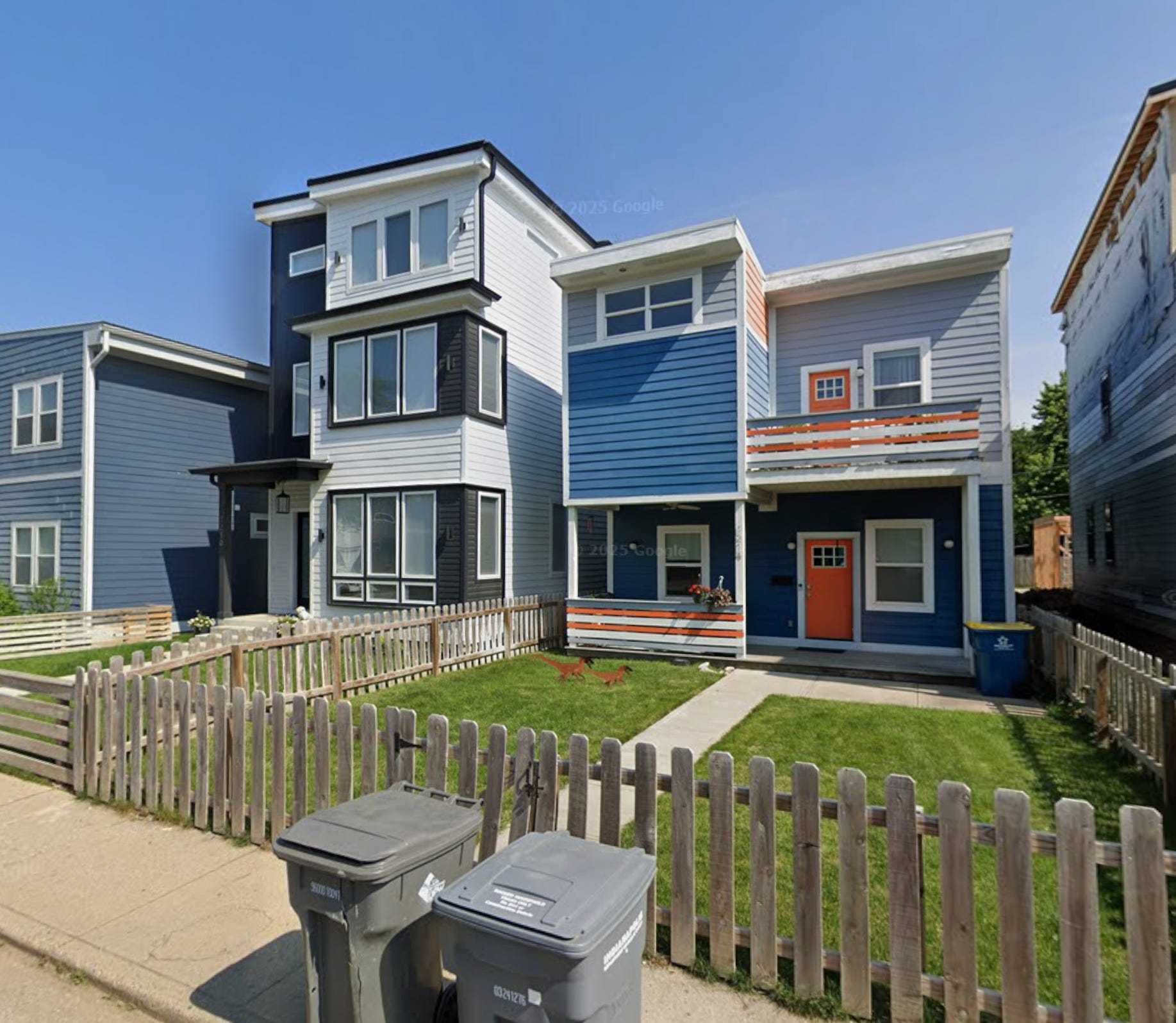
At the same time, “financialization” of housing has reached critical mass. Institutional investors and large-scale developers, armed with low-cost capital, are acquiring properties in appreciating neighborhoods, demolishing existing affordable stock, and replacing it with high-end inventory. This process extracts equity from the neighborhood. When a long-term resident sells their property to a developer for $50,000, and that developer builds two units selling for $300,000 each, the value creation ($650,000+) leaves the community. Property values rise, but long-term residents feel overshadowed by the new spaceship houses next door.
The Double Up Housing framework reverses this flow. It enables the homeowner to retain the land, execute the lot split, and either develop the second unit themselves or sell the newly created lot at a market rate to a builder who agrees to community standards. This keeps the decision-making power, and profit, in the hands of the resident. That’s how it should be, duh!
This strategy also meets a critical demographic reality: the changing needs of the American homeowner. A significant portion of residents in these established neighborhoods are aging in place or find themselves as 'empty nesters' maintaining family-sized homes and massive yards that no longer serve them. For them, that 80-foot deep backyard isn't as much a playground for long-gone children but now a liability to mow and maintain. The DUH framework flips this script. It transforms that burden into an open canvas, a financial lifeline that allows them to downsize their maintenance responsibilities without leaving the community they love.
By monetizing that surplus land, they gain the liquidity to retrofit their home for accessibility or simply enjoy retirement, effectively turning a weekly chore into a nest egg. We all love nest eggs, right?
The Inspiration
The DUH is chiefly inspired by California’s Senate Bill 9 (SB 9), signed into law to address that state’s out of control acute housing crisis. SB 9 fundamentally altered the concept of single-family zoning by allowing two primary distinct actions by right:
✅Urban Lot Split: The division of a single-family residential parcel into two separate parcels of approximately equal size.
✅Two-Unit Development: The construction of two residential units on a single-family lot (or one on each of the two new lots resulting from a split), effectively allowing four units where one previously existed.
The critical innovation of SB 9 is not just the density it allows, but the process by which it allows it. SB 9 mandates Ministerial Approval, meaning that if a project meets objective zoning standards, the local government must approve it without a public hearing or discretionary review. This removes the “political risk” that often kills small-scale development.
Key SB 9 provisions relevant to other cities include:
Owner Occupancy Requirement: Applicants must sign an affidavit intending to occupy one of the units as their principal residence for at least three years. This prevents corporate speculators from utilizing the streamlined process.
Parking Relaxations: Local agencies cannot impose parking requirements if the parcel is within one-half mile of a high-quality transit corridor.
Objective Standards: Agencies can only deny a project based on specific health and safety impacts, not subjective “character” arguments.
While most states (thankfully) operate under different state statutes, the core principles of California’s SB 9 (administrative streamlining > owner-occupancy protection > density-by-right) form the intellectual backbone of our proposed model. If cities wanted to, they could realistically pass their own micro version of SB 9, and set the stage for much-needed incremental housing construction.
The Inspiration pt. 2 The Indianapolis Opportunity: Deep Lots and Alley Access
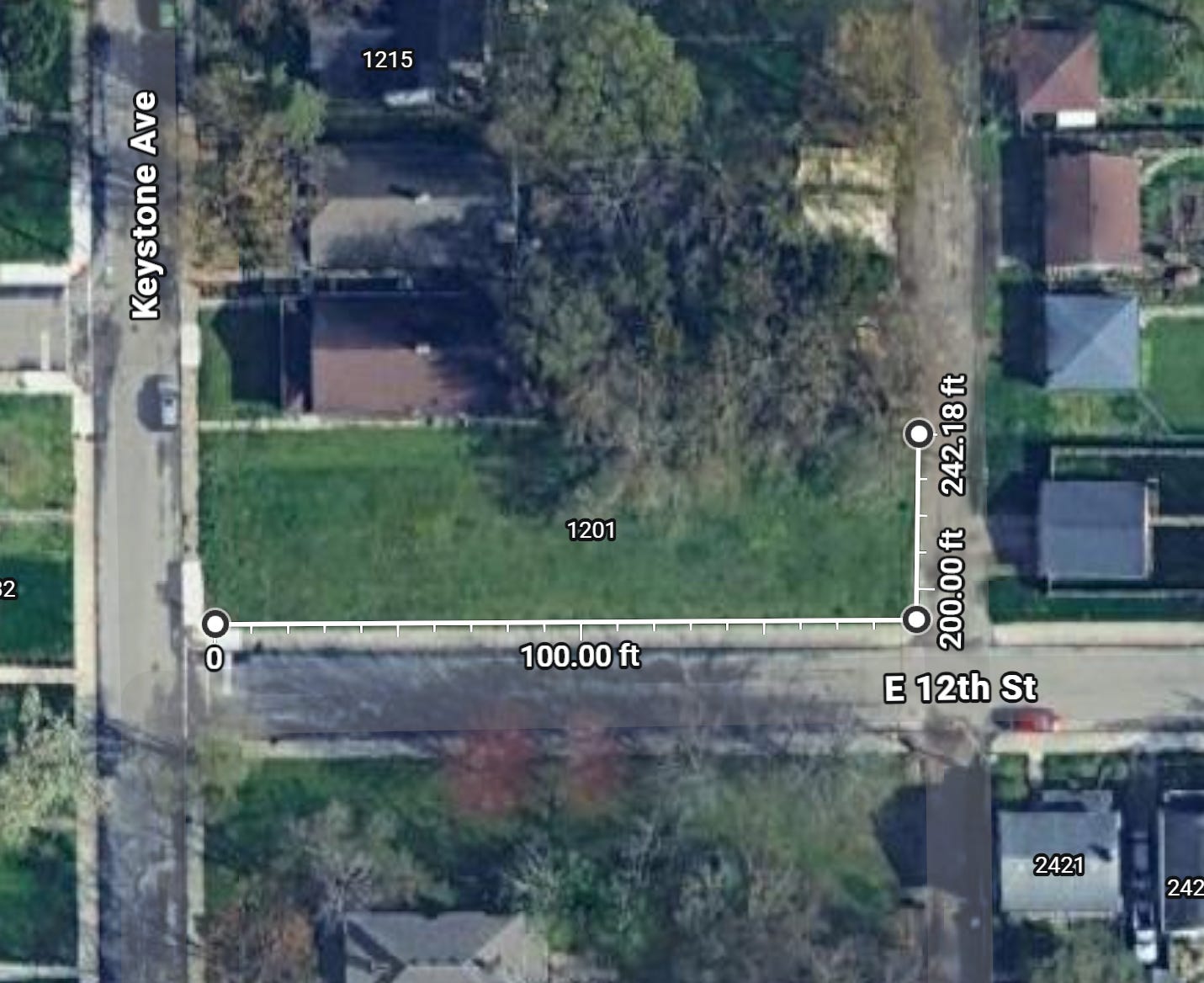
Indianapolis (alongside many other Midwest metros) possesses a unique urban morphology that makes it arguably more suited for this strategy than many California cities which feature hilly, ungraded, or odd-shaped parcels that aren’t as easy to subdivide. The historic “City of Indianapolis” (pre-Unigov boundaries) is characterized by a grid of deep, narrow lots, often measuring 25 to 50 feet in width and 130 to 200 feet in depth.
The Spatial Inefficiency: A typical 5,000 to 7,000 square foot lot in Center Township often features a house positioned near the street, leaving a massive rear yard of 60 to 80 feet in depth
The Alley Network: Unlike many suburban environments, these lots are frequently served by a robust (albeit crumbling) network of public alleys. This infrastructure provides independent vehicular and pedestrian access to the rear of the lot, making backyard development physically feasible without disrupting the street frontage. This again is typical of many legacy cities across the United States, particularly within the Midwest.
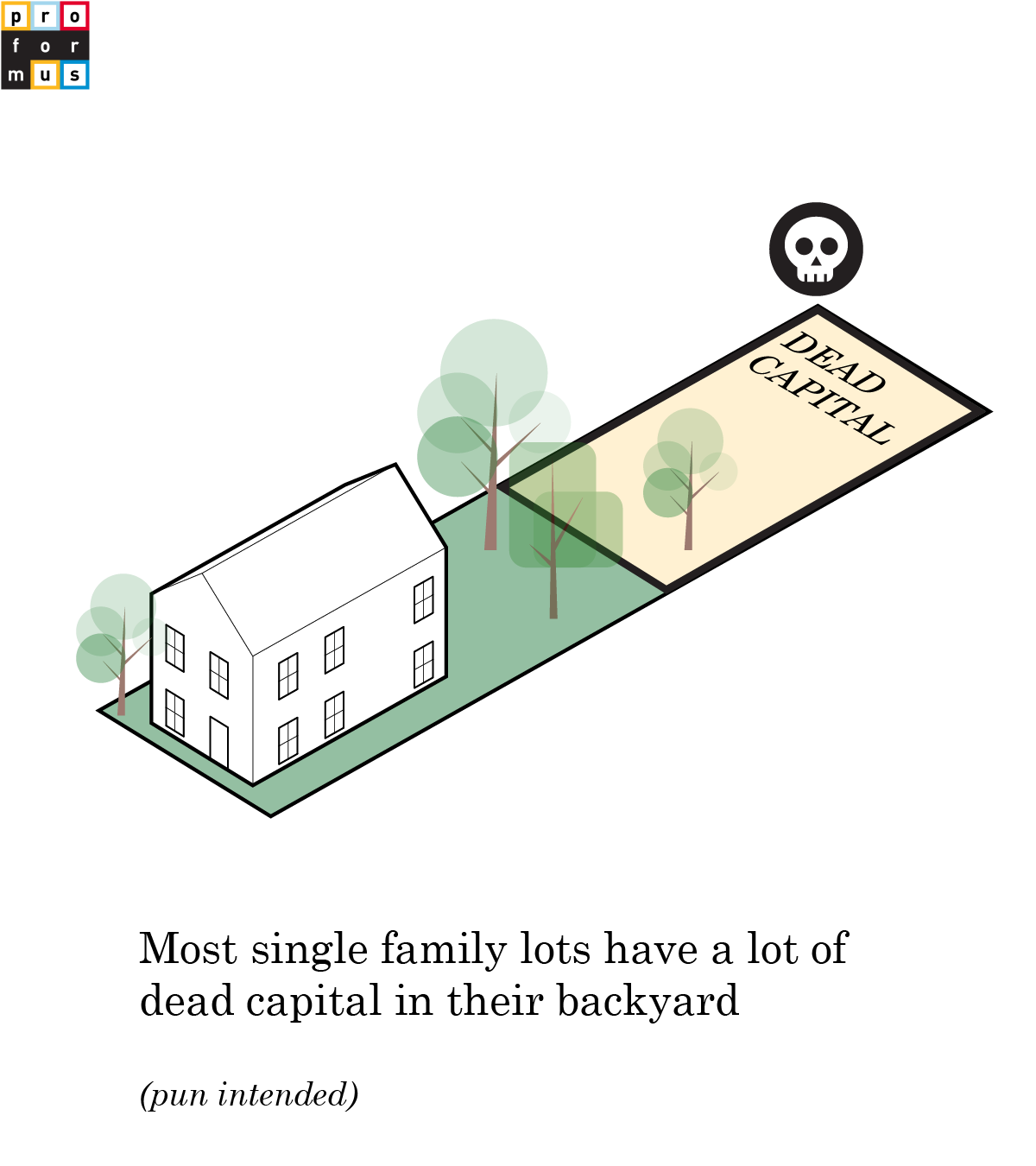
Currently, this backyard land is “dead capital.” It requires maintenance (mowing) and generates property tax liability but provides no income. The DUH activates this land. However, the current regulatory environment makes accessing this potential incredibly difficult for a non-professional. DUH acts as the bridge between the physical potential of the land and the regulatory permission to use it.
So how do we go from this to this? We follow the DUH framework.
The Double Up Housing Framework follows 6 basic steps.


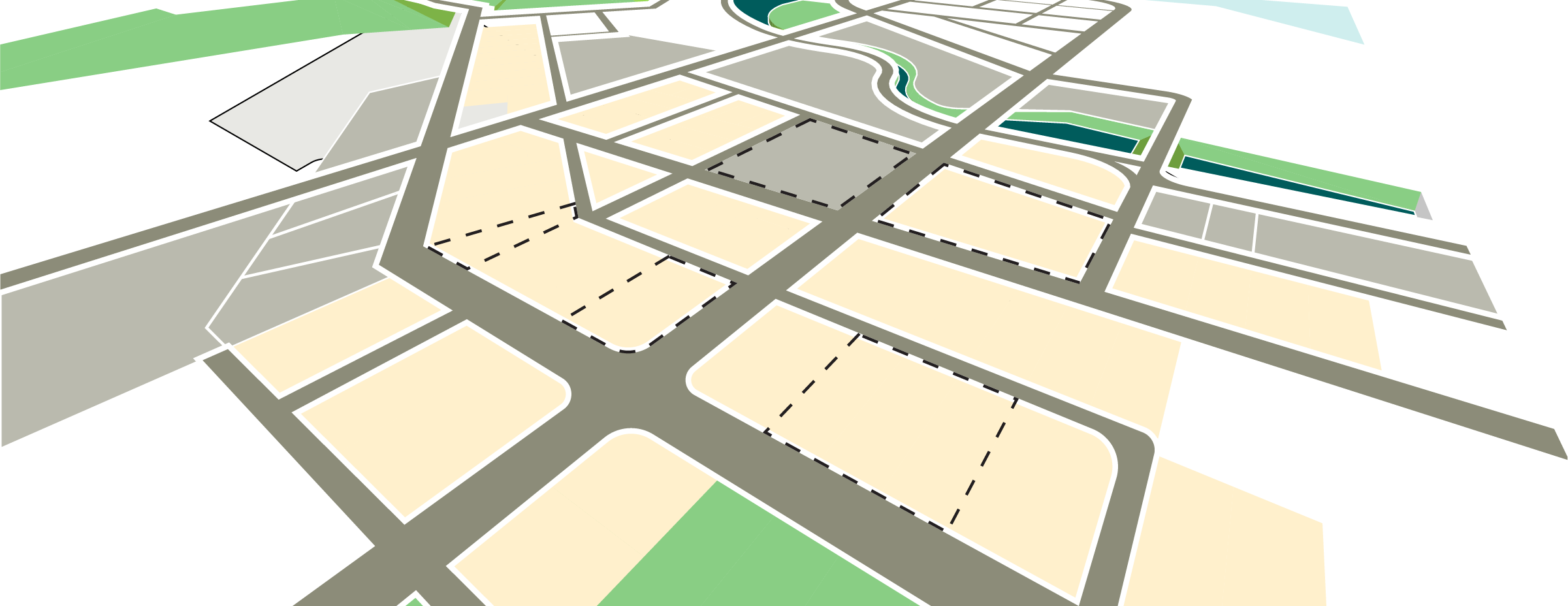
Identification of development pressure zones that are primarily single-family or low-density residential.
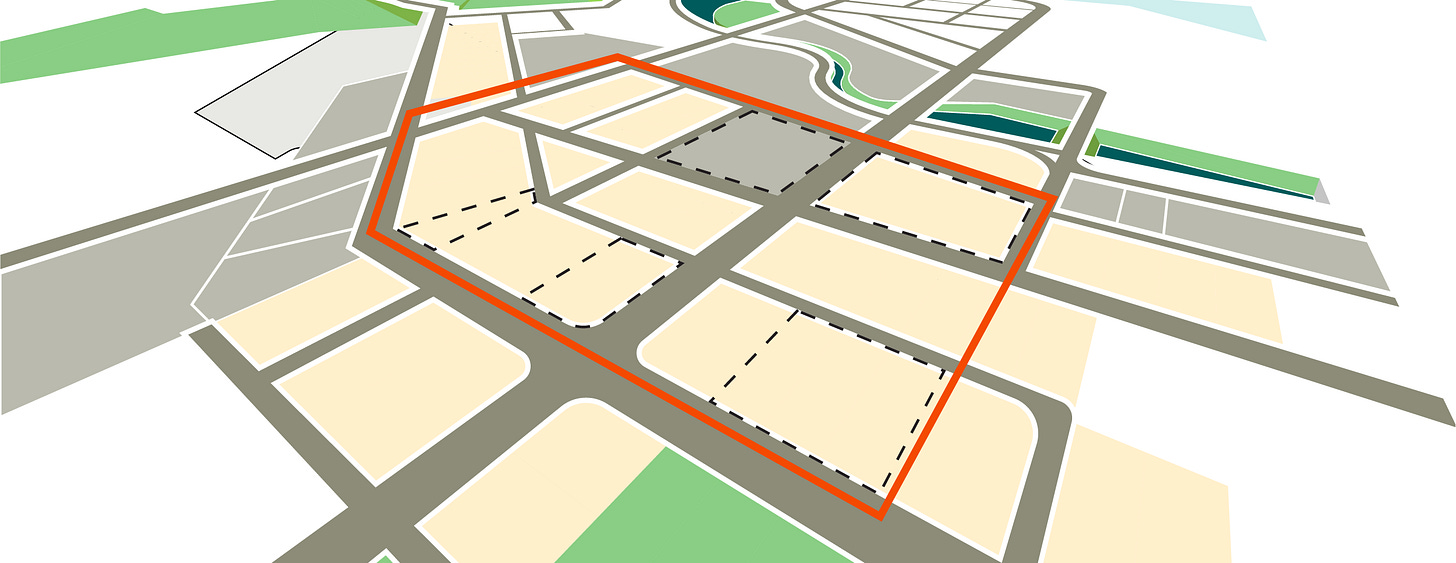
Adopt a Homestead Infill Opportunity Overlay (pronounced “hi-oh!”): The Overlay grants specific rights to property owners who meet the definition of a “Homestead Developer” (defined as an owner-occupant of at least 3 years). This is the meat of the model. Much like SB 9, this amendment could probably eschew minimum lot sizes and traditional parking requirements and encourage more efficient residential layouts and circulation patterns. Such an amendment may encourage shared parking drives, flag lots, etc. All of a sudden, the lots available to develop in an in-demand neighborhood could double overnight without any additional land being created. This would create an ecosystem of small, entry-level parcels that are easier to develop than large multifamily units. The amendment would have criteria that residential homeowners must have lived on the property as a primary residence for three or more years. Thus, a database of applicable parcels is created as eligible for the zoning amendment.
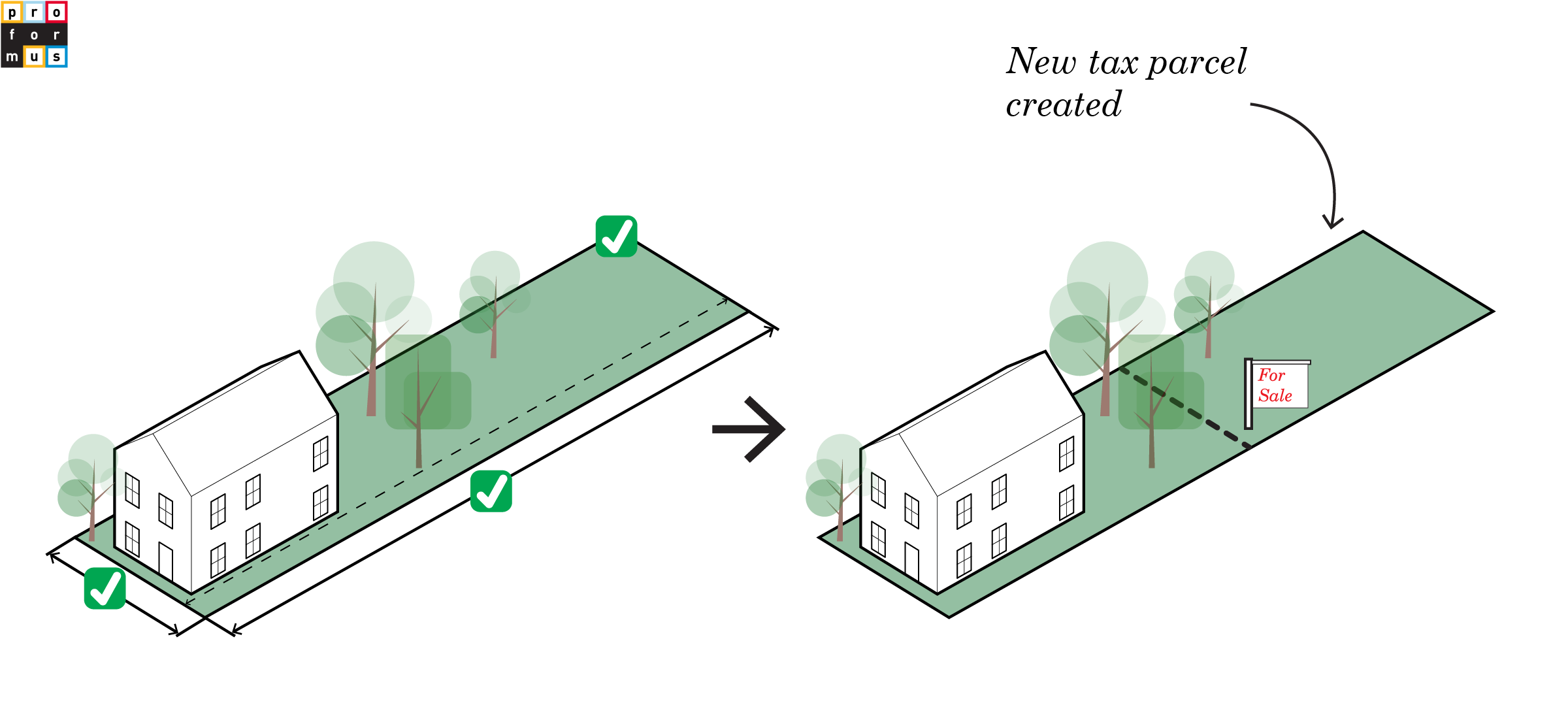
Permit by-right allowances for minor subdivisions within the HIOO after very basic criteria is met. This facilitates efficient use of staff and private sector time to further streamline development. The HIOO establishes “Safe Harbor” setbacks for split lots — by-right allowances would be permitted for parcels that meet a checklist criteria. This is simply allowing the subdivision to occur if the lot is wide enough, if it has adequate setbacks, or has enough area, for instance. If these three or four boxes are checked, then the lot can be subdivided.3
The legislative body, by adopting the HIOO, has effectively "pre-approved" this density in the designated zones, rendering individual hearings redundant. A town or city’s website could have a basic intake form that allows the resident to input their lot dimensions and existing structure dimensions. In conjunction with approved survey, once these are verified, the subdivision is by-right approved and ready for doubling up.

Now, this is where the DUH toolkit comes in. It’s the potatoes of the process. Once the new HIOO parcel is created, it is listed on an online repository matching property with development partners. Think of it as an online matchmaker of the three main entities needed to make development happen. Property owners could choose to a.) do nothing b.) self-develop or c.) sell to a development partner. The Civic-created inventory of subdivided HIOO parcels is matched to developers, builders, and lending partners. The cosmic gumbo of each municipality’s DUH repository relies on a Service Provider List that allows property to contact for:
vetting of development potential to ascertain feasibility on site by site basis
list of builders and/or contractors willing to work on such projects
community financial institutions willing to support or facilitate such development

Cities usually already have a gauntlet of community development corporations and CDFIs to pull from as investment partners to administer both local and federal funding. Creative places could look to these entities and their baseline of general contractors to establish a tertiary list of approved vendors for these types of DUH subdivisions. This process makes it easy for residents to a.) either build the property up themselves or b.) sell it on the market to a developer or CDC willing to invest upfront, allowing the original property owner to recoup their equity and grow wealth. Ideally, the city has a pre-approved catalog of housing typologies that could be suited for such parcels.
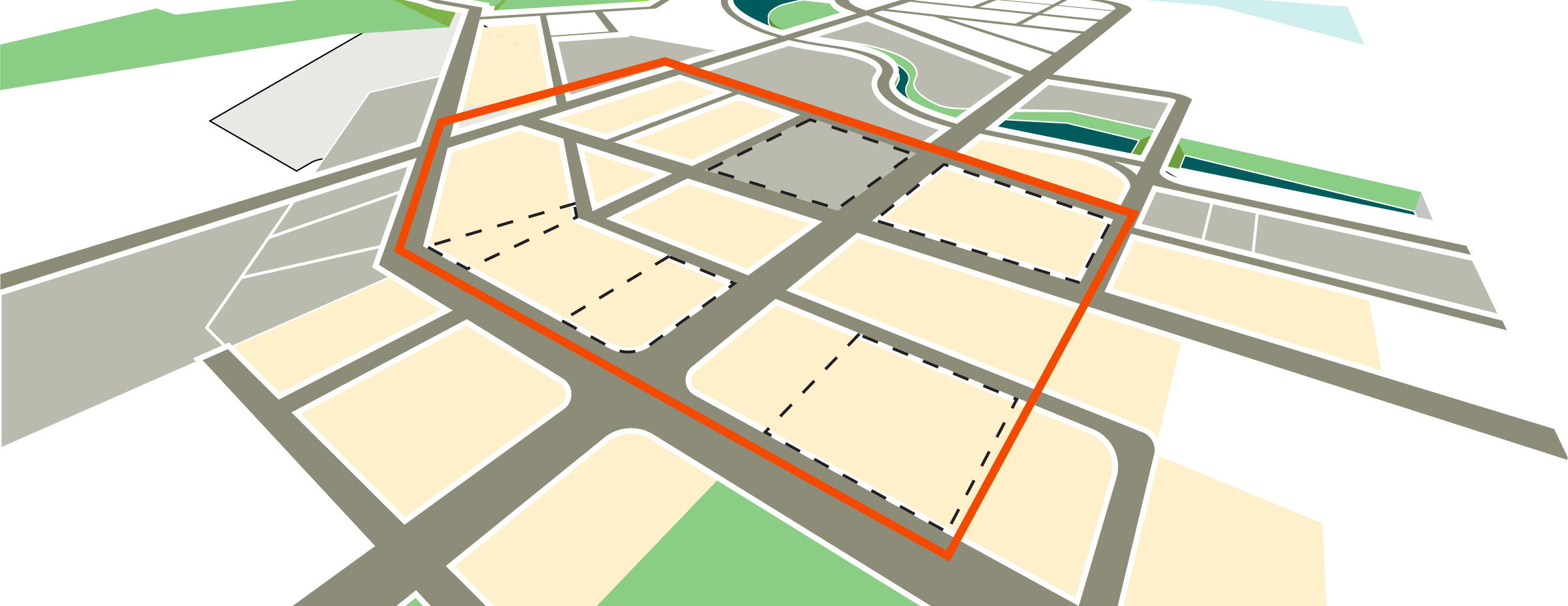
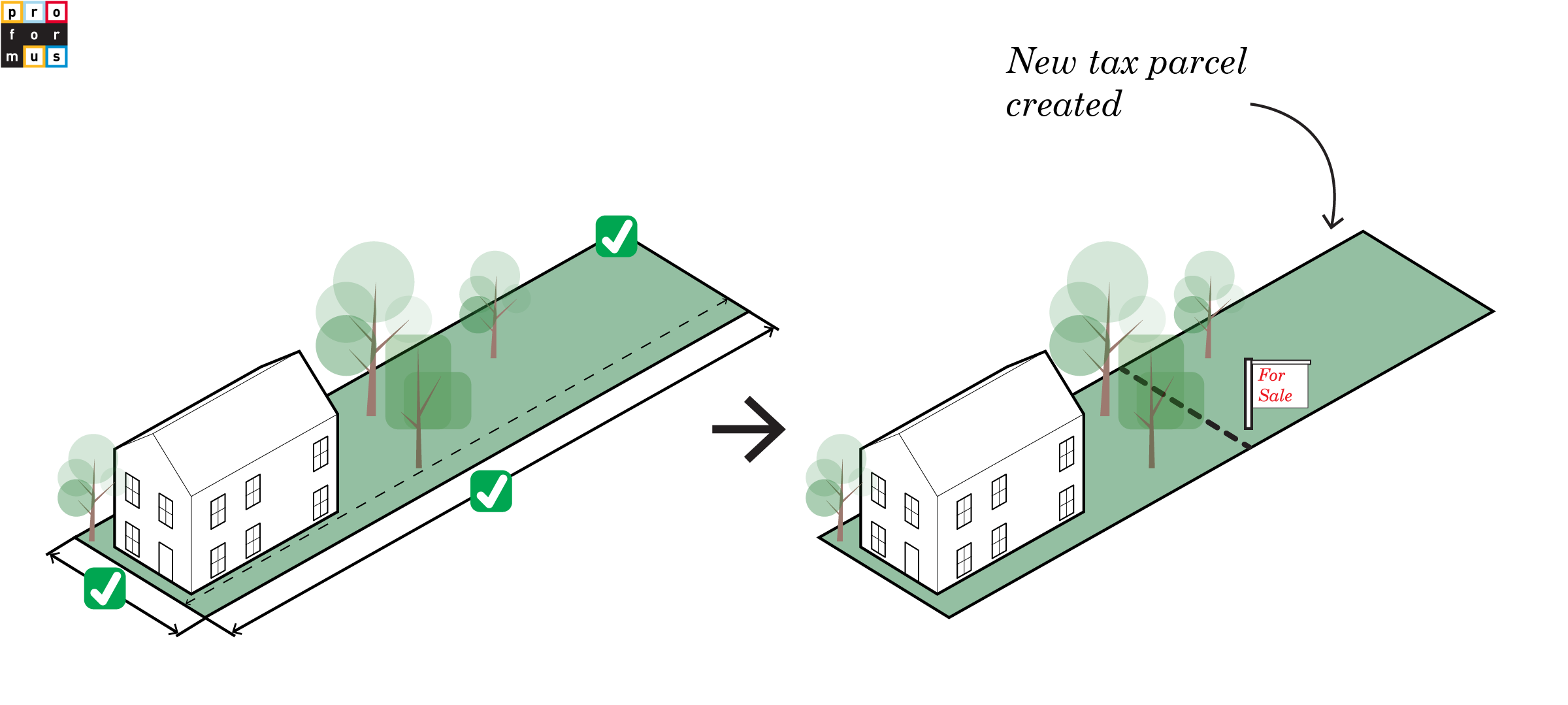


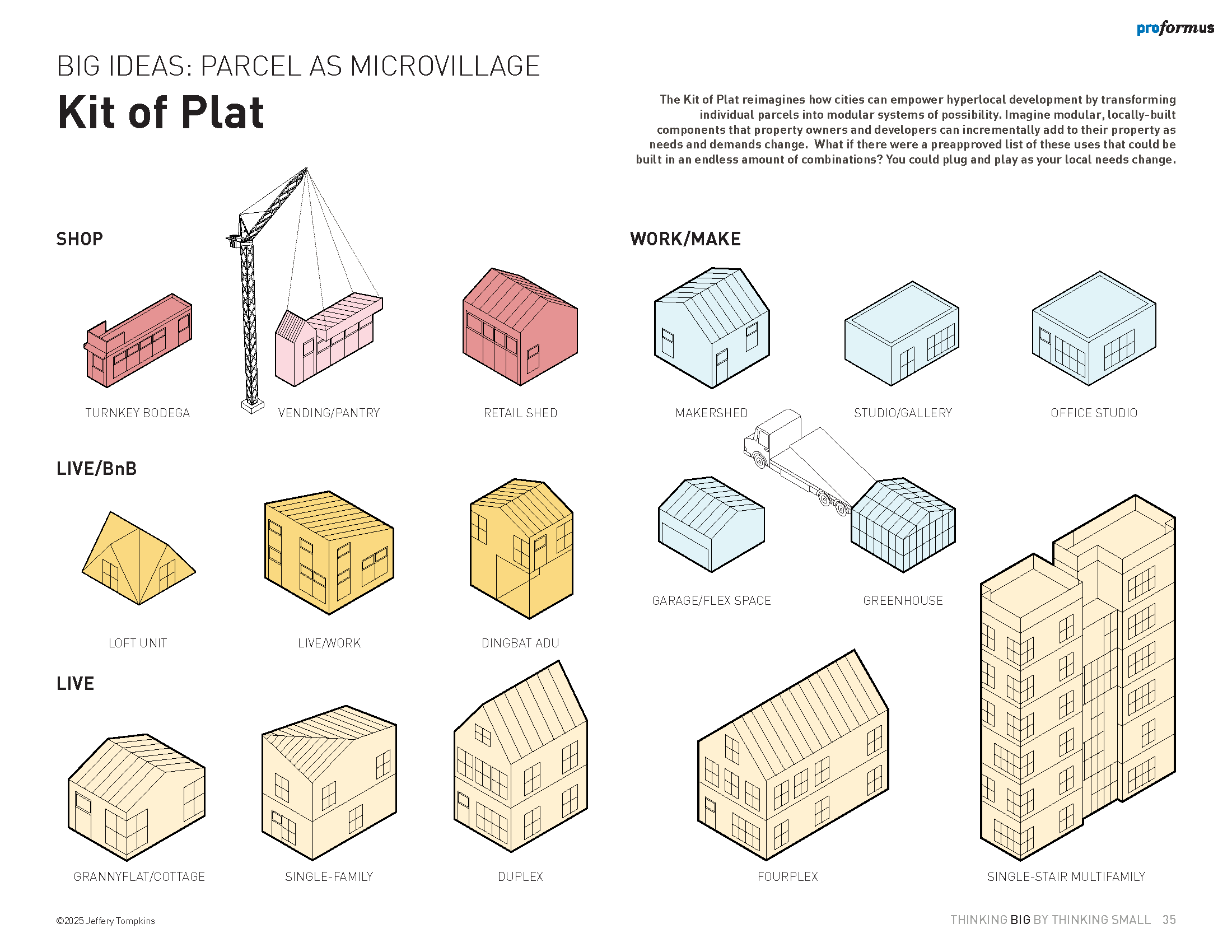
The end result is a variety of new parcels created from no additional land, and hopefully a civic ecosystem that thrives on supporting long-term residents while making way for new neighbors. It’s a town, place, or city taking stock, fostering opportunity, and matching those opportunity partners. It’s a lot like matchmaking, but wealth-building instead. Actually, that’s what every good match should be anyway.
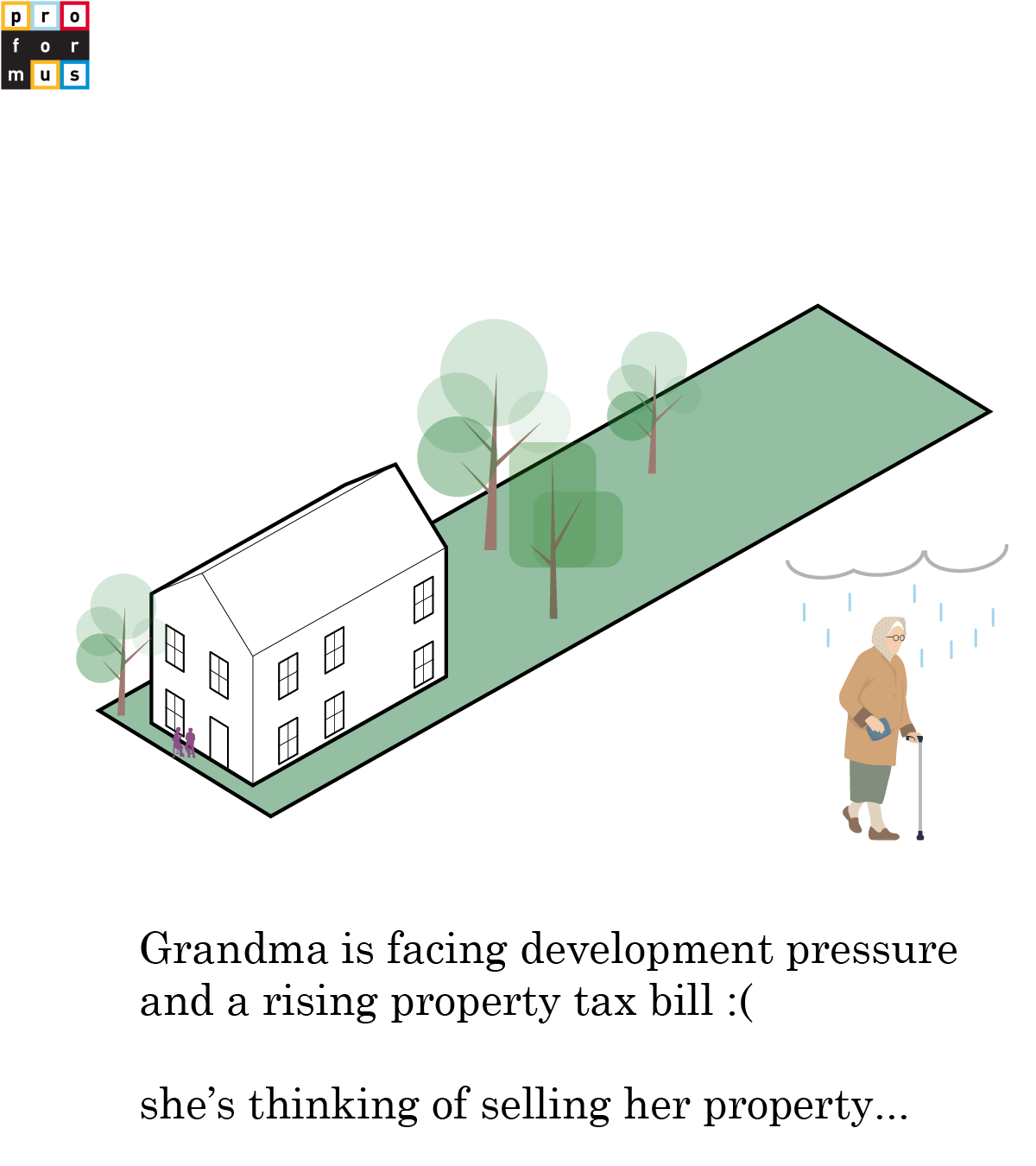
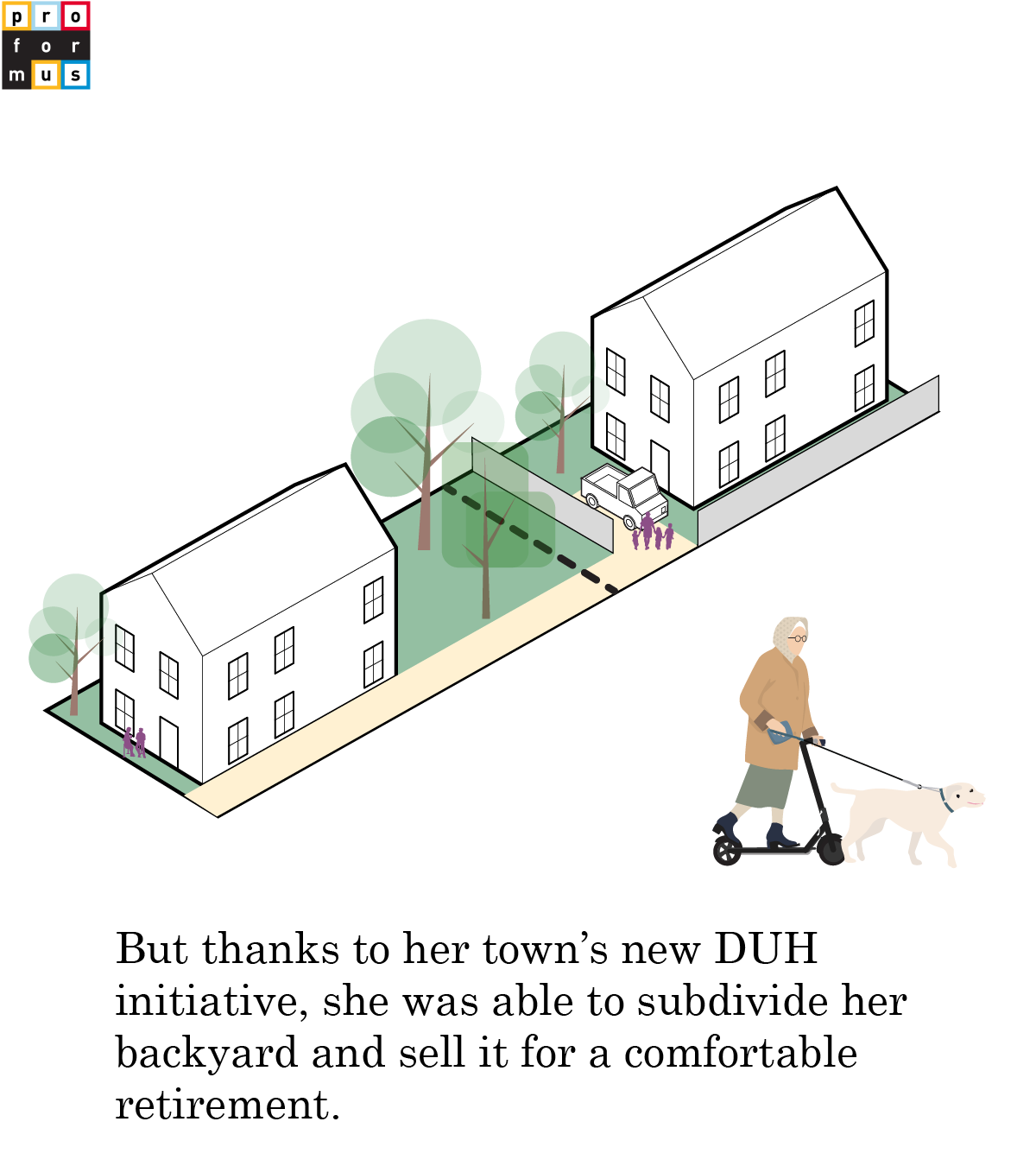
In the DUH model, density is actually the antidote to displacement. Perhaps, eventually Grandma will even have some family move in with her as she ages, allowing what was once just one parcel to become a multi-generational, multi-family village. What can your land do for you?
All photos @2025 Proformus (unless otherwise noted)
Author’s note: dear reader, the subsequent text gets into the nitty-gritty minutiae of what such a model could actually look like and gets very planner-y. Feel free to skip.
Okay, but like how would this actually work in the real world?
Let’s be real for a second. Most cities don’t have pre-approved typologies. Most don’t probably have the bandwidth or internal capacity to set up a catalog like the toolkit listed above. However, most cities DO have a housing crisis and are understaffed with limited capacity for existing staff review, permitting, etc. But most already have these resources listed somewhere online. What they don’t have is 1.) the zoning amendment and 2.) a site putting all the resources together.
To construct a functional DUH Toolkit for an example community, say, like Indianapolis, we must first perform a quick audit of the existing zoning codes to see what is preventing housing. Or better yet, which zones are best for a single to double conversion. You don’t need to be an urban planner or lawyer to look up your city’s zoning code. Most towns and cities have these published online. You want to look for residential zoning districts that have limited setbacks and feature smaller footprints.
Specific to Indy, the Indianapolis Zoning Ordinance (Chapters 740-744) establishes the dimensional standards for development. Most single-family neighborhoods are zoned D-2, D-3, D-4, or D-5. These districts typically mandate large minimum lot sizes (e.g., 15,000 sq. ft. for D-2, 5,000 sq. ft. for D-5) that preclude lot splitting on standard parcels.
However, the ordinance contains two specific districts that are ideally suited for the Single to Double goals: D-5II and D-8.
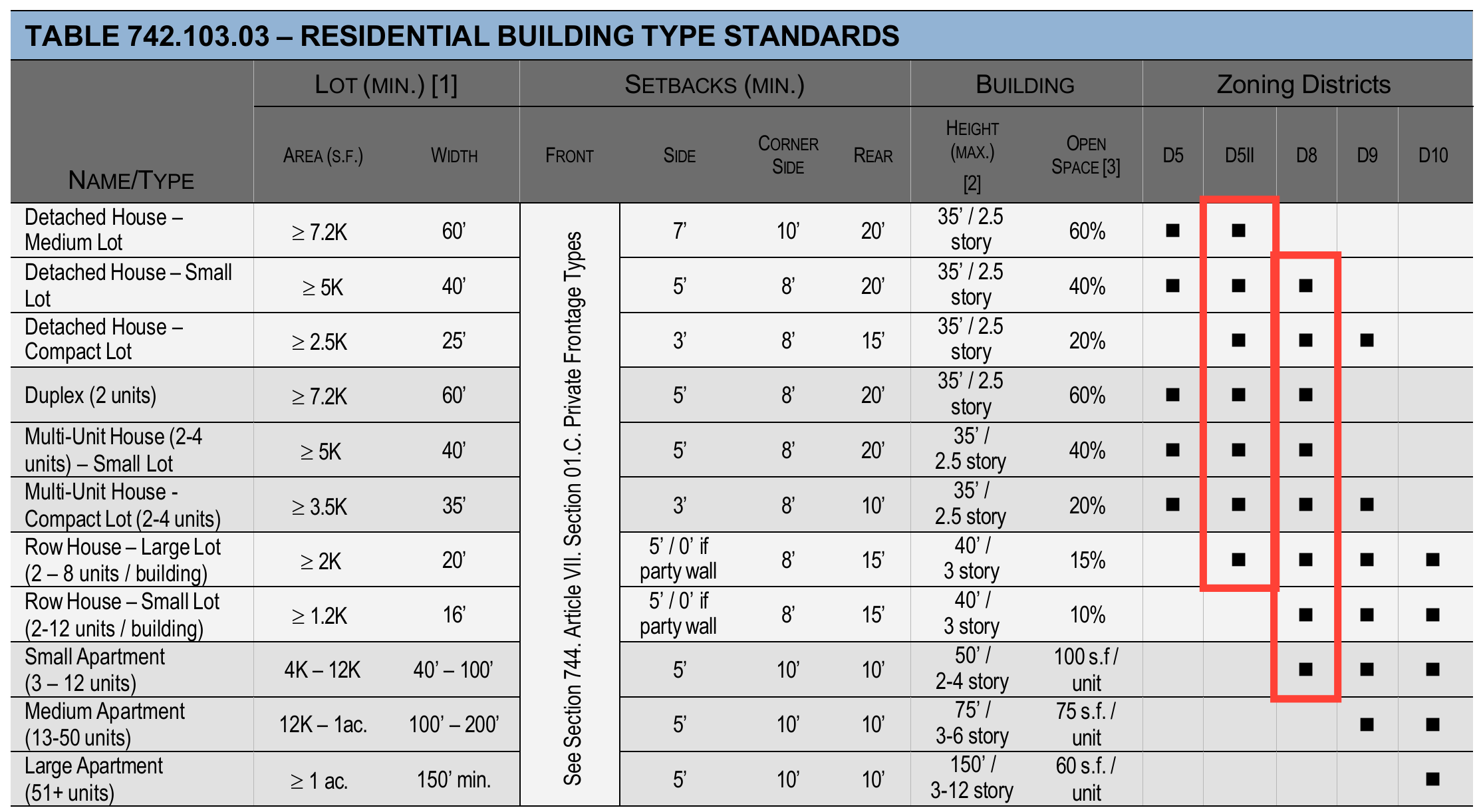
The D-5II District (Dwelling District Five-Two)
The D-5II district would be the “scalpel” of any future zoning amendment. It is explicitly designed for high-density, single-family contexts.
Intent: The ordinance describes D-5II as providing “the smallest single-family lot size in the zoning ordinance” and notes it is intended for “built-up areas... where infill development is necessary”.
Dimensional Superiority:
Minimum Lot Area (Detached): 2,800 square feet. This is the critical figure. It creates a mathematical possibility that D-5 (5,000 sq. ft.) does not. A standard 40’ x 140’ lot (5,600 sq. ft.) can be split into exactly two 2,800 sq. ft. lots under D-5II zoning.
Minimum Lot Width: 40 feet. This matches the historic platting of many Indy neighborhoods, reducing the need for variance requests regarding lot width.
Zero Lot Line Option: D-5II permits zero-lot-line development, allowing a structure to be placed on one side property line. This aggregates the side yards into a single, usable open space on the other side, a crucial design feature for maintaining quality of life on small lots.
Strategic Application: D-5II is the target zoning for homeowners who wish to execute a Fee Simple Split, essentially creating two legally distinct pieces of land that can be sold separately.
The D-8 District (Dwelling District Eight)
The D-8 district would be the hammer of Indy’s DUH Toolkit. It is a flexible, high-density residential classification.
Intent: Designed for “urban dwelling” including single-family, two-family, and multi-family mixtures. It supports densities from 5 to 26 units per acre.
Dimensional Flexibility:
Minimum Lot Area: For single and two-family dwellings, the D-8 district has no required minimum lot area other than what is necessary to meet setbacks and coverage. This is a massive advantage for irregular lots that might fall slightly short of the 2,800 sq. ft. D-5II threshold.
Permitted Uses: D-8 allows for duplexes and triplexes by right, whereas D-5II is primarily for detached or attached single-family.
Strategic Application: D-8 is the target zoning for homeowners who wish to Densify and Hold: building a duplex or a substantial Carriage House (ADU) to generate rental income without necessarily selling the underlying land.
Multiplication and Subdivision
While zoning dictates what can be built, typically towns, counties, or cities have a subdivision ordinance that dictates how a new lot is created. We have to look here to see the mechanism by which we can double up. Here in Indy, we have a distinct pathway for small-scale splits called the Minor Subdivision.
Definition: A subdivision is classified as “Minor” if it:
Results in three (3) or fewer lots.
Fronts on an existing street with adequate improvements.
Does not involve the construction of new public streets.
Does not require the extension of municipal facilities (sewer/water mains) other than laterals and sidewalks.
Relevance: A Double Up Housing project, taking one lot and making it two, fits this definition perfectly. This exempts the project from the onerous requirements of Major Subdivisions, such as traffic impact studies or complex bond requirements.
Public Hearings are a thing
Often, a significant barrier to small-scale development is the public hearing process. Hearings are unpredictable, expensive (requiring legal representation and notice mailings), and prone to neighborhood opposition based on subjective aesthetics.
However, Indiana Code (IC 36-7-4-701) and the local ordinance allow for a Waiver of Public Hearing for Minor Plats.
Mechanism: The Plat Committee may grant primary approval without a public hearing if the subdivision complies with the Zoning Ordinance and Subdivision Control Ordinance and involves no new streets.
Strategic Importance: This waiver is the Indianapolis equivalent of SB 9’s “Ministerial Approval.” If the Toolkit can ensure that a homeowner’s application is technically perfect and compliant with the zoning (D-5II or D-8), they can bypass the public hearing entirely. This reduces the approval timeline from 3-6 months to approximately 30-45 days.
Structural Barriers to Implementation
Despite these favorable regulations, significant structural barriers prevent widespread adoption:
The Rezoning Barrier: Most eligible lots are currently zoned D-3, D-4, or D-5. To access the benefits of D-5II or D-8, the homeowner must first file a Rezoning Petition. This is a legislative act requiring a public hearing before the Metropolitan Development Commission (MDC) and potentially the City-County Council. It carries a high filing fee ($600+) and significant political risk. These high fees and bureaucratic hurdles discourage resident-developers.
The Infrastructure/Drainage Hurdle: Even Minor Subdivisions require drainage review. For a single lot, hiring a civil engineer to design a drainage plan ($3,000-$5,000) creates a disproportionate cost burden.
Appraisal Gaps: In many target neighborhoods, the cost to build a new unit exceeds the current appraised value of the surrounding homes, making traditional financing impossible.
Our theoretical DUH Toolkit is designed specifically to dismantle these three barriers.
DUH Toolkit Mechanism Part 1 – Policy Overlay
To operationalize the Double Up Housing concept without requiring thousands of individual rezoning hearings, let’s say we adopt a “Homestead Infill Opportunity Overlay” (HIOO - remember, it’s “hi, oh!”)
The HIOO would be adopted as a text amendment to existing zoning ordinances. Here in Indy, it could be mapped to coincide with the Compact Context Area (the historic urban core) as defined in the Comprehensive Plan.
Key Provisions of the HIOO
The Overlay grants specific rights to property owners who meet the definition of a “Homestead Developer” (defined as an owner-occupant of at least 3 years). This is a standard definition in line with other exemptions for homeowners, especially first-time buyers.
Instead of the discretionary legislative rezoning process, the HIOO creates an Administrative Map Amendment process.
Process: A Homestead Developer submits an application to the Planning Division demonstrating that their lot meets the dimensional standards of D-HIO.
Review: Staff reviews the application for technical compliance.
Outcome: If compliant, the zoning map is updated administratively to D-HIO. No public hearing is required.
Justification: The adoption of the HIOO effectively pre-approves backyard sublot density in the designated zones, meaning we don’t need hundreds of individual staff meetings. They’re already overburdened. This saves so much time.
The “Safe Harbor” Building Envelope
To additionally streamline development, the HIOO establishes “Safe Harbor” setbacks for split lots.
→ Front Setback: Averages of the block face (contextual).
→ Side Setback: Fixed at 3 feet (minimum for fire separation) on one side and 0 feet (zero lot line) on the other, or 5 feet aggregate.
→ So What?: Projects designing within this envelope are exempt from Variance of Development Standards requests, further eliminating hearing risks.
Parking Reform
Mirroring Cali’s SB 9, our HIOO would prohibit the requirement of off-street parking for any unit created under this program if the property is located within 1/4 mile of a transit line (IndyGo).
→ Impact: This saves approximately 160-300 square feet of land per lot and $2,000-$5,000 in paving costs, making tight lot splits physically and financially feasible.
DUH Toolkit Mechanism Part 2 – The Process Workflow
The Toolkit replaces the current opaque development process with a clear, step-by-step roadmap for the homeowner.
Phase 1: Feasibility and “The Cut”
The “Split Check”: The homeowner uses the Toolkit’s digital portal to verify if their lot (e.g., 6,000 sq. ft.) can support a D-5II split (needs 2,800 sq. ft. x 2). No cost.
Survey & Plat: The homeowner engages a surveyor from the DUH Service Provider List to create the Preliminary Plat. Cost is on homeowner, typ. $1k to $4k.
Note: the policy solution of DUH is to eliminate cost burdens for households facing development pressures. A rotating fund should be set up if possible to alleviate cost burden by cash-strapped households for soft costs such as surveys.
Waiver Application: The homeowner submits the Minor Subdivision application with a request for Waiver of Public Hearing, citing the HIOO/D-5II compliance.
Recording: Upon administrative approval, the plat is recorded. The single property is now two legal tax parcels. We are cooking!
Phase 2: Financing and Development
Project Budgeting: The homeowner selects a builder or developer from the Approved client/vendor list.
Loan Origination: The homeowner applies for the INHP Revive Indy + Build loan (see below), utilizing the future rental income of the second unit to qualify.
Construction: The vetted builder constructs the unit.
Case Study: The Tale of Two Futures
To truly understand the impact of the DUH toolkit, we have to move beyond zoning theory and look at the “kitchen table” economics of a typical family in the Near Eastside.
Let’s look at The Williams Family. They have owned a home on a 50’ x 150’ lot for 20 years. Their house is paid off, but it needs a new roof and other nagging issues like a leaky foundation. Their property taxes are rising year over year. The house is worth $140,000 on paper, but they are cash-poor.
Here is how their future plays out in two different regulatory environments.
Scenario A: The Status Quo (The “Cash-Out & Get Out” Trap)
Without a clear path to utilize their extra land, the Williams family is approached by a speculative wholesaler. “We buy houses for cash,” the flyer says. Facing tax pressure and repair costs, they sell.
The Transaction: They sell the entire property for $80,000 (a “quick cash” discount).
The Displacement: The family moves out. They must now rent or buy in a cheaper, further-out suburb, disconnecting from their community network.
The Developer Play: The developer demolishes the house. They split the lot and build two “tall skinny” modern homes, selling each for $325,000.
Total Value Created: $650,000.
Value Retained by Family: $80,000.
Value Extracted from Neighborhood: $570,000.
Scenario B: The HIOO “Double Up” (The Wealth Building Engine)
Under the Homestead Infill Opportunity Overlay (HIOO), the Williams family has options. Instead of selling the whole farm, they sell the back 75’.
The Transaction: Using the DUH Toolkit, the family finds a surveyor through the online vender portal and files a minor subdivision by-right ($2,500 total cost). They now own two deeds: their house, and a vacant buildable lot in the back.
The “Builder Match” Sale: They do not have the desire to build, so they sell the new rear lot to a vetted local builder (from the Toolkit list) for $45,000.
The Renovation: They use the $45k proceeds to put on a new roof and pay property taxes for the next decade.
The Outcome: The builder constructs a new unit on the rear lot. The Williams family stays in their home.
Value Retained by Family: $185,000 ($140k Home Value + $45k Cash).
Value Extracted: $0. The equity stays with the resident.
The Bottom Line: In Scenario A, the family leaves with $80k and the neighborhood loses a legacy resident. In Scenario B, the family stays with $185k in total wealth, the neighborhood gains a new family in the back, and the “gentrification” pressure is absorbed by the backyard, not the existing home.
Anti-Displacement and Equity Measures
Again, this is just a theoretical exercise and the following institutions I have not talked with at all. But the most potent criticism of density initiatives is that they accelerate gentrification. DUH should integrate structural safeguards to ensuring the wealth generated benefits existing residents with existing community partners.
The Owner-Occupancy Covenant
To prevent the Toolkit from becoming a loophole for institutional investors:
Requirement: Any applicant utilizing the Administrative Rezoning, Waiver of Public Hearing, or INHP Revive Financing must sign a recorded commitment.
Terms: The applicant must occupy one of the units on the subject property as their primary residence for a minimum of three (3) years following the completion of the project.
Enforcement: Annual residency affidavit. Violation results in the revocation of the Certificate of Occupancy and the clawback of fee waivers.
The Community Land Trust (CLT) Partnership
Look for land trusts as potential partners. Here, Indianapolis Community Land Trust (Indy CLT) and partners like Kheprw Institute could play a vital role.
The “Split-and-Preserve” Option: Not every homeowner wants to be a landlord.
Mechanism:
Homeowner splits the lot using the Toolkit.
Homeowner sells the newly created lot to the Indy CLT at a negotiated rate.
Indy CLT utilizes public subsidies (HOME funds, HoTIF, TIF) to build a permanently affordable home on the new lot.
Benefit: The homeowner receives a cash infusion (for the land) without taking on construction debt. The neighborhood gains a permanently affordable unit. The CLT handles the development risk.
LISC Emerging Developers Support
For homeowners who do want to build but lack expertise, the Toolkit leverages LISC’s Emerging Developers Growth Initiative (EDGI).
The “Fee Developer” Model: EDGI trains local minority developers. The Toolkit creates a mentorship pipeline where an EDGI graduate acts as the “Project Manager” for the homeowner.
Role: The EDGI manager handles permits, builder draw requests, and inspections. They earn a fee (e.g., 5% of project cost), gaining portfolio experience while protecting the homeowner from contractor disputes.
The “Double Up Indy” Pilot
I recommend launching a pilot program in three distinct neighborhoods: Near Eastside (high appreciation pressure), Riverside (large lots, historic context), and Mars Hill (working-class stability).
Target: 25 Projects in Year 1.
Incentive: Full waiver of all City filing fees (Rezoning, Platting, Improvement Location Permit) and a $5,000 “Pre-Development Grant” for surveys and soil testing.
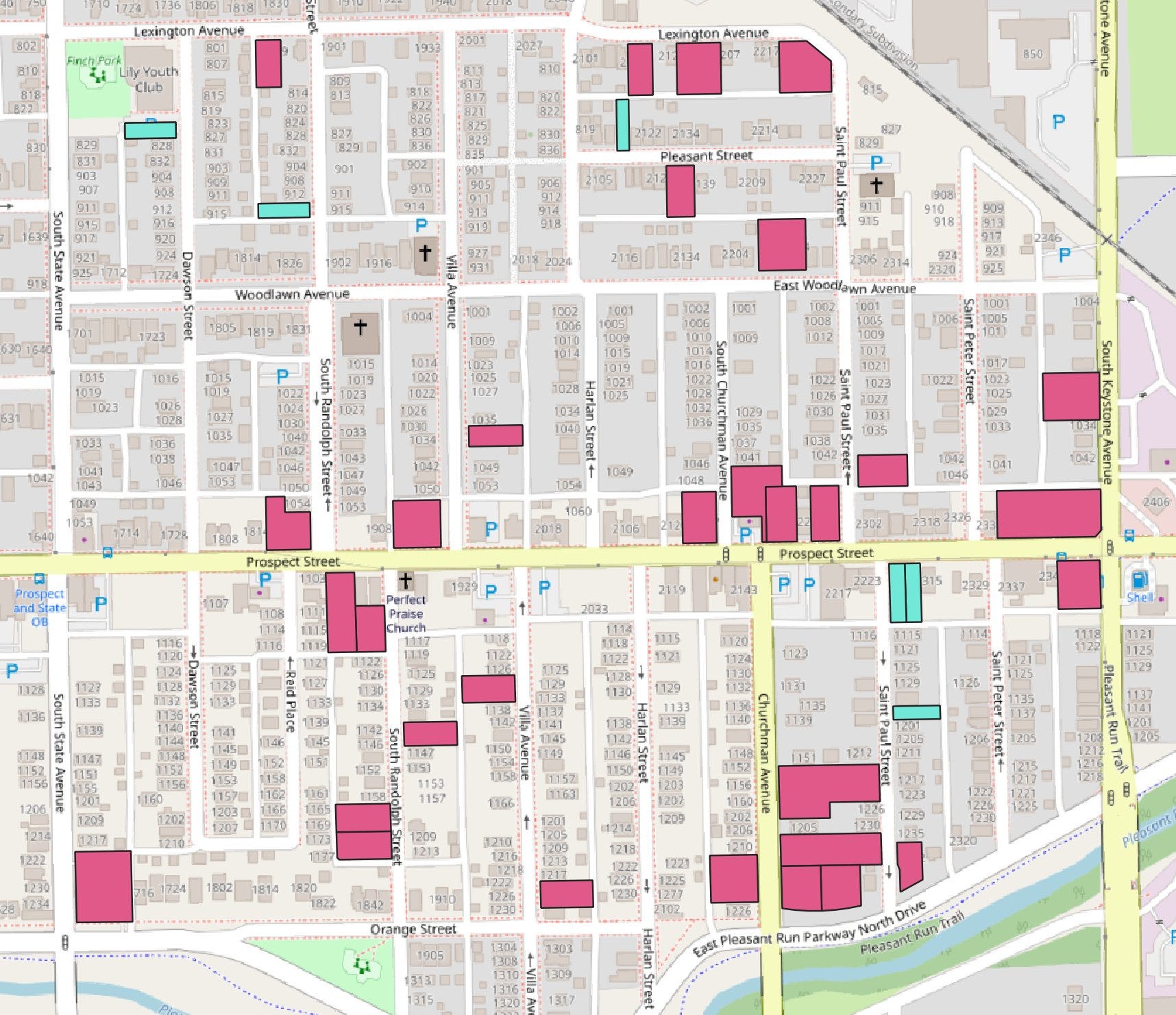
The City should update its GIS tools to create a “Split Potential Map.”
Criteria: Identify all residential lots >5,000 sq. ft. with alley access and applicable zoning (D-5II, D-8)
Outreach: Direct mail campaign to these owners: “Did you know your backyard is worth $50,000? Don’t sell it, develop it.”
Policy Levers
To enact this Toolkit, the City-County Council should:
Adopt the HIOO Text Amendment: Codifying the administrative rezoning and parking reductions.
Revise the Fee Schedule: Creating a “Homestead Developer” fee class that reduces costs for owner-occupants.
Fund the Pattern Book: Allocating budget to the Department of Metropolitan Development (DMD) to commission the standard plans that could be part of a pre-approved typologies for resident-developers.
Fin.
The Single to Double Housing Toolkit would represent a fundamental shift in how Indianapolis conceives of growth. It moves away from the reliance on outside capital and empowers the city’s most committed stakeholders, its residents, to build the future of their neighborhoods. By aligning the regulatory permissions of the D-5II and D-8 districts with the financial innovation of INHP and the construction capacity of local builders, Indianapolis can create a housing market that creates wealth for the many, rather than the few. While this is a housing strategy, so many things are downstream of adequate shelter. This is just as much a neighborhood stabilization and economic justice strategy, turning what we call missing middle into a found opportunity.
Interested in learning how your town, place, or city could double their housing potential overnight? Let’s get in touch. jeffery@proformus.com
The ongoing historic preservation efforts in inner city neighborhoods to confront development is probably misguided at best. While I think it’s coming from a good place (stopping speculative development) my question is: how does encasing a neighborhood in amber allow current (or future) residents the ability or flexibility to adapt to future conditions? Say Grandma wants a new house addition. That just became prohibitive under new restrictions. Say, new housing wants to get built to allow families to be near each other? Nah, that’s not allowed in the character of the neighborhood. What ends up happening is that those with means stay, get repairs, and get locked into the long-term benefit of reduced supply. Or, simply, trapping many without the means to repair a slower, but more painful, way out. Those on the ground floor now can sit back, watch their land appreciate while demand swells around the neighborhood, then sell high later. The historic designation did the exact opposite thing it was intended to prevent, except now no housing gets built at all. Look at areas like Chatham Arch in Indianapolis (which underwent its own historic designation in the early 1980s) to understand. Exclusivity has a price. It’s often north of 400k to buy in Chatham now.
The framework used here is one of three upcoming models as part of Proformus’ attempts to create policy solutions to the housing crisis. Each framework will come with a published and illustrated toolkit. More to come.
Note: Potential hold ups with site feasibility should not get in the way of by-right approval of subdivision because the site could still be sold on the market at which point the future owner or developer would be responsible for those costs anyway. At the point of approving a subdivision, it is not necessary to burden the property owner with the costs and logistical hurdles of utility verification, lateral design, or service availability letters. These are construction feasibility issues, not entitlement issues. The act of subdivision merely creates the legal container for development; it does not authorize the pouring of a foundation. By requiring full utility vetting (sewer, gas, water) at the subdivision stage, municipalities effectively force homeowners to pay for full civil engineering before they even know if they have a legal lot. This reverses the logical order of operations. The creation of the tax parcel should be a geometric exercise based on zoning compliance; the vetting of infrastructure capacity belongs in the subsequent Improvement Location Permit (ILP) phase. If a newly created lot faces unique utility challenges (e.g., a difficult sewer connection), the market will adjust the sale price accordingly, or the future builder will engineer a solution during the design phase. Halting the administrative subdivision based on potential downstream engineering challenges simply keeps the land locked in a state of “dead capital” and prevents the homeowner from accessing the equity required to solve those very problems.
Really wonderful ideas here for Midwestern towns. For parcels that are not alley loaded, do you suggest fee simple flag lots or just constructing an ADU with a rental pro forma?
We've recently passed an ADU ordinance where I live, but the missing piece of financing effectively took building an ADU off the table for me.